

Gaming without battle passes.
Takes without paywalls.
And stories without reposts.

RetroSpace Review: A Must-Buy for Fans of Looking Glass-Style Immersive Sims
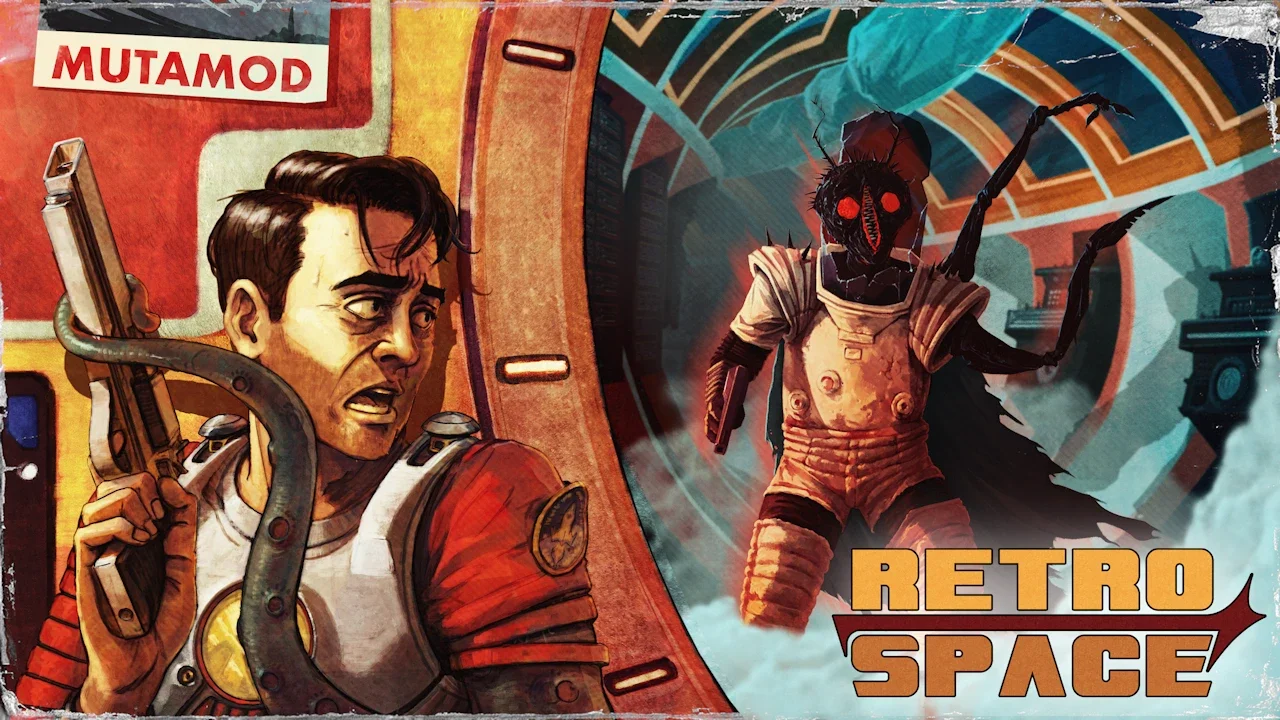
Thief, System Shock, Deus Ex: Few modern immersive sims fill those enormous shoes as convincingly as RetroSpace. It takes particular inspiration from the masterful System Shock 2—and as this review shows, it can absolutely hold its own.
Did your childhood self own a physics experiment kit? Yes? Say no more—your life is an open book. You definitely tried using that thing to create a black hole so you could study its properties. Sadly, the kit wasn't quite up to producing a full-grown warp in spacetime, which is why you've felt vaguely incomplete ever since.
Listen: The moping ends today. Because RetroSpace (Steam page) is here—and at least it shows you its own take on what happens inside a black hole. It tosses you in indirectly, mind you, aboard a gigantic space station that's been sucked into the cosmic vacuum cleaner. Nice: No spaghettification for you. Less nice: The station isn't taking it nearly as well.
Sound interesting enough? Then all you need is a soft spot for the playful immersive-sim gameplay of the '90s and '00s, because RetroSpace brings it back in remarkably authentic fashion. It isn't a perfect sandbox shooter, though: The story, enemy AI and performance in particular give us plenty to talk about.
The story: Remember Citade... uh, Aurora 1
The space station where the (fleshy) pieces start flying in RetroSpace is called Aurora 5. It originally traveled through space like a generation ship in search of another Earth. Now, however, it's little more than an enormous steel hulk abandoned by humanity.
Okay, small correction: There's still one human roaming its halls—you, a janitor who's woken from stasis ahead of schedule. The other members of your species are either lying in their stasis pods with their asses firmly clenched or prowling the corridors as monsters ranging from ridiculous to terrifying. What the hell happened here? That's exactly what you'll spend the next 20 hours finding out. Take things slowly and you could easily stretch that to 25.
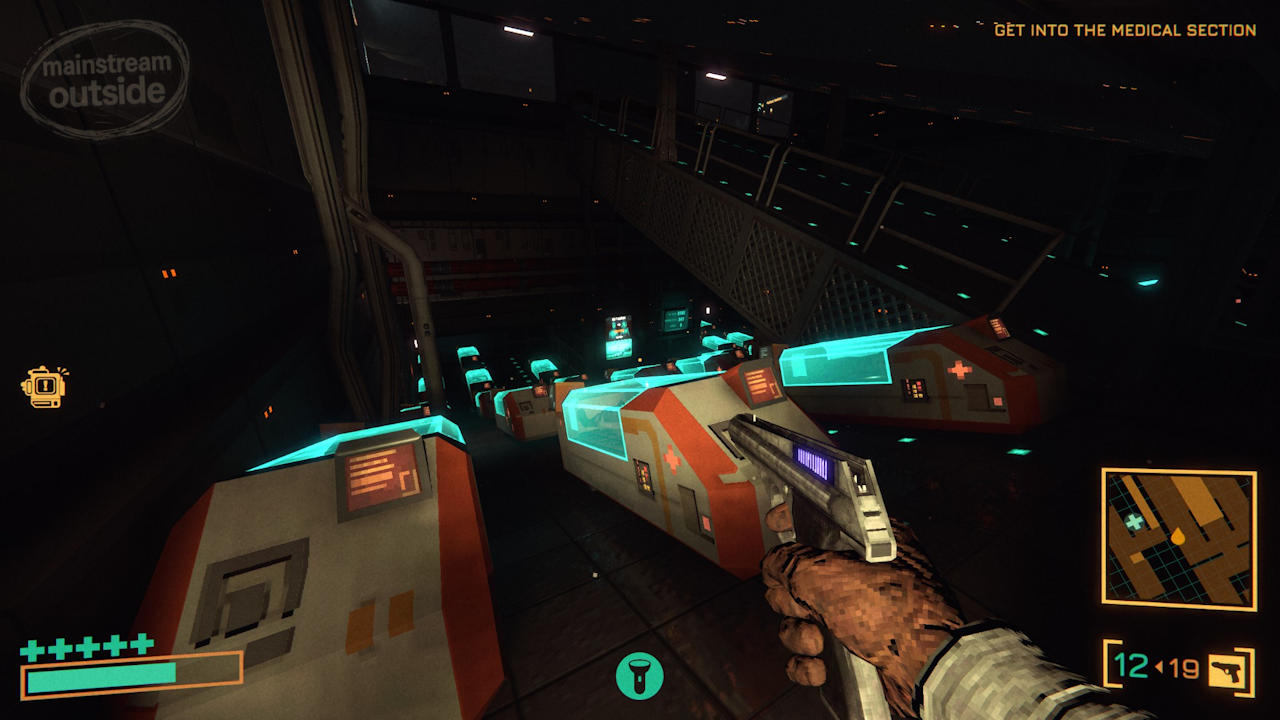
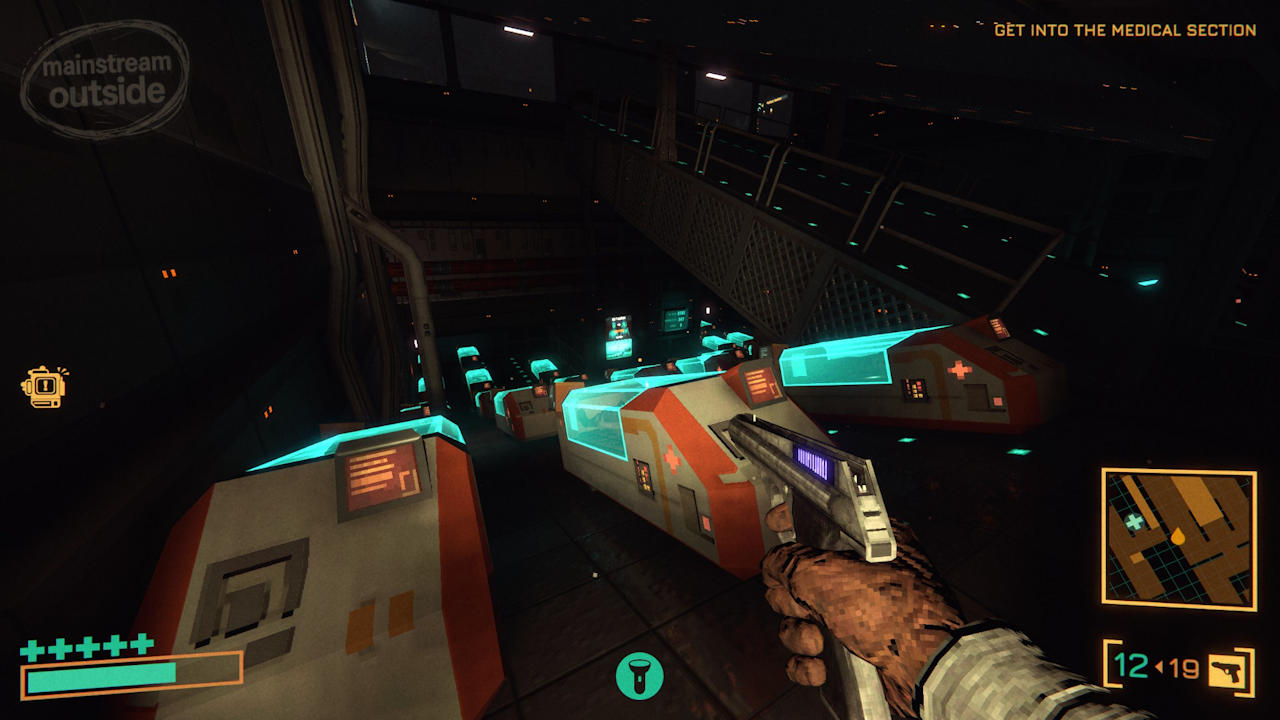
At the beginning of the game, stasis pods—both empty and occupied by corpses—dominate the scenery.
The developers tell you right in the game description that Aurora 5 has been dragged into Stephen Hawking's favorite object of study. But since your janitor is suffering from total amnesia, you'll have to uncover even that little detail yourself. How? Much like in RetroSpace's apparent role model, System Shock 2: You use terminals and collect notes, voice messages and video logs that gradually reveal what happened aboard the station.
All the story material is collected in a portable Pip-Boy-style hub interface, with one interesting wrinkle: Messages you read at terminals have to be saved to it manually. Cinematic cutscenes only occasionally add another piece to the narrative. I certainly noticed their relative scarcity during my playthrough, but I can't say I missed them.
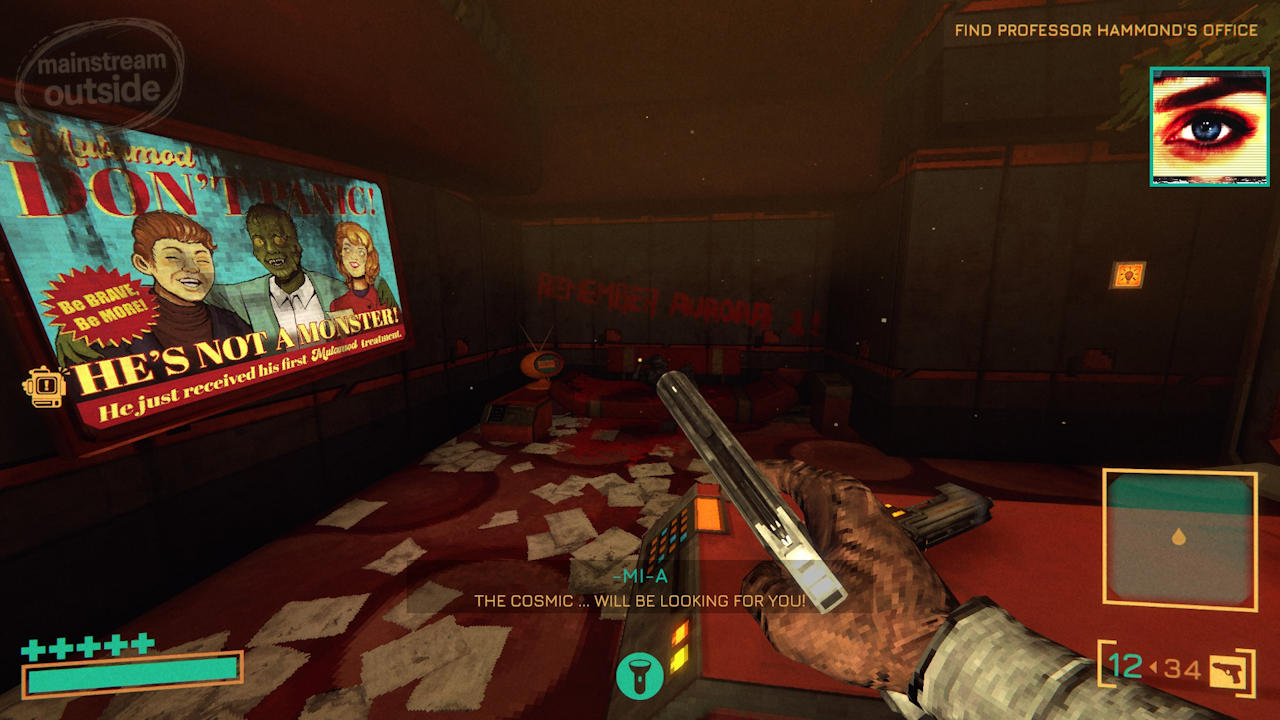
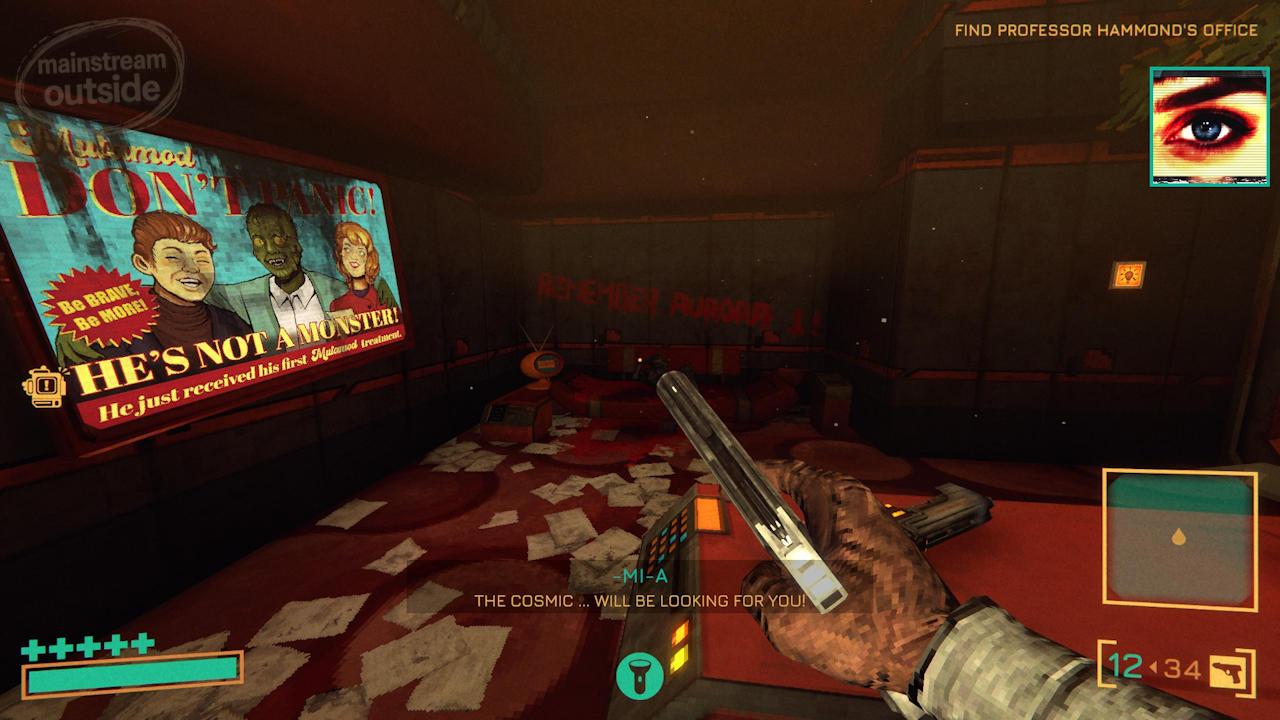
"Remember Aurora 1": System Shock 2 fans will immediately know what this message, written in blood on the wall, is referencing.
Time jumps are its ace in the hole
What did bother me somewhat was how uneventful much of the storytelling feels. Mind you, both Amira—the ship AI patched into your hub interface—and the suitably nebulous Dr. Nebula have plenty to say. But they're more mission givers than drivers of the plot and rarely do much to build suspense. Mysterious elements such as a floating spectral child watching the janitor briefly make RetroSpace more intriguing. Overall, though, the story simply takes too long to get going.
The time jumps caused by the black hole, on the other hand, are excellent because they change the time period without changing the location. A future version of the Aurora is particularly atmospheric, combining heavy destruction with morbid, oppressive darkness. Atmosphere, incidentally, is where RetroSpace truly shines. Partly because its audio doesn't sound like it was pulled straight from a royalty-free sound library. I genuinely felt transported back into a classic immersive sim—and The Wild Gentlemen deserve a pat on the back for that.
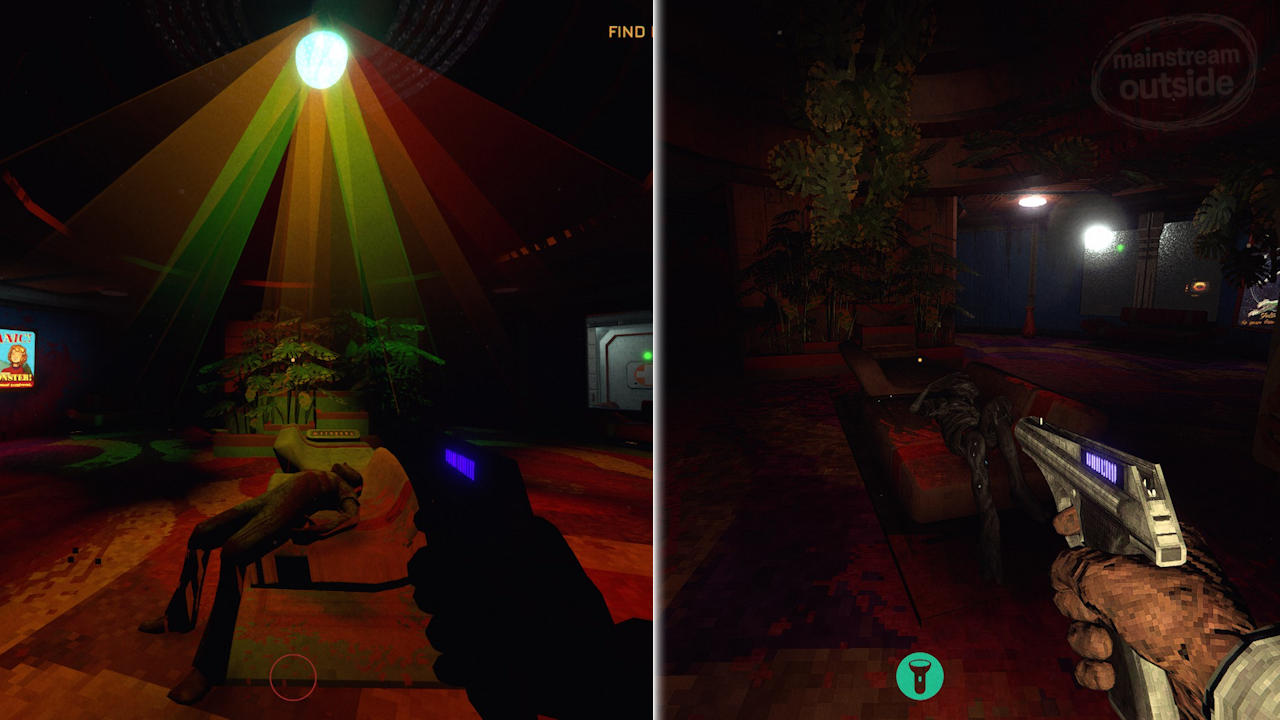
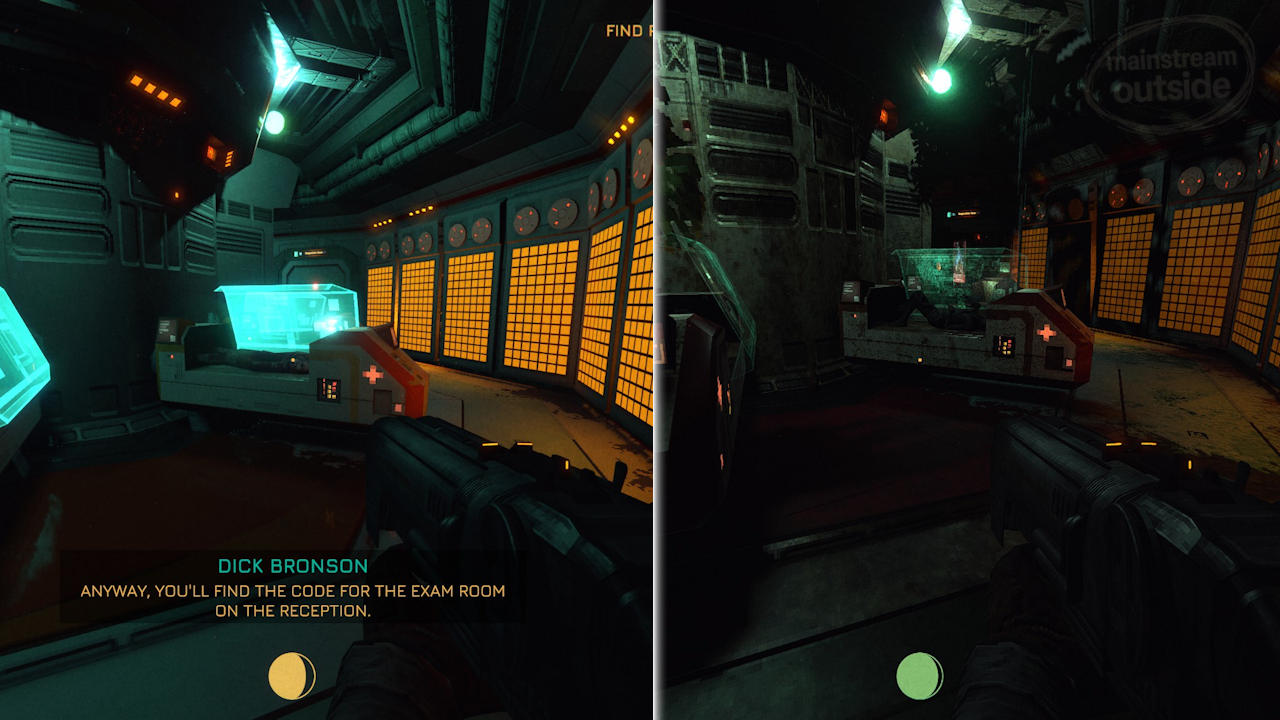
After a time jump, the station has changed. Here are before-and-after shots of two areas.
The world: 1970 meets 1999 meets 2026
A good immersive sim obviously needs a substantial world that doesn't just sit there looking pretty, but actually pulls the player into it. As a fairly large, semi-open and unusually interactive space station, Aurora 5 already has the right ingredients. But what exactly does the place look like—and what can you actually do there?
For even more terror in retro space, check out our review of the sci-fi horror game Routine.
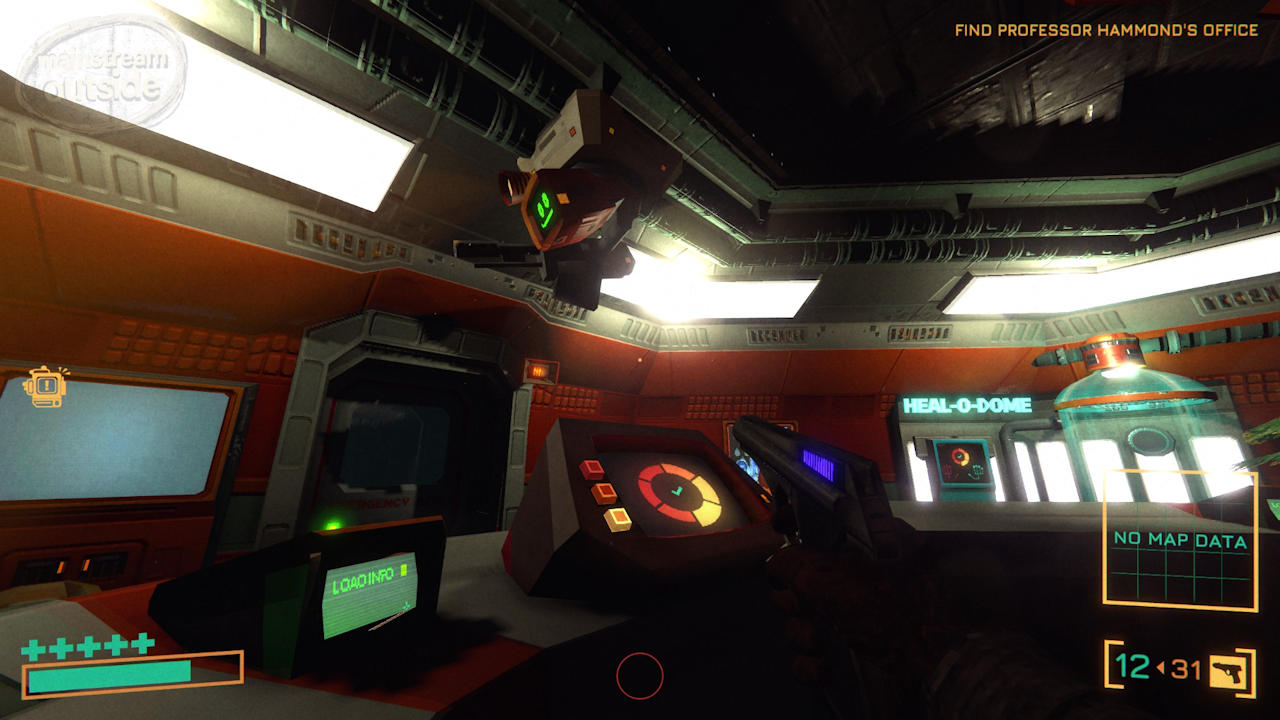
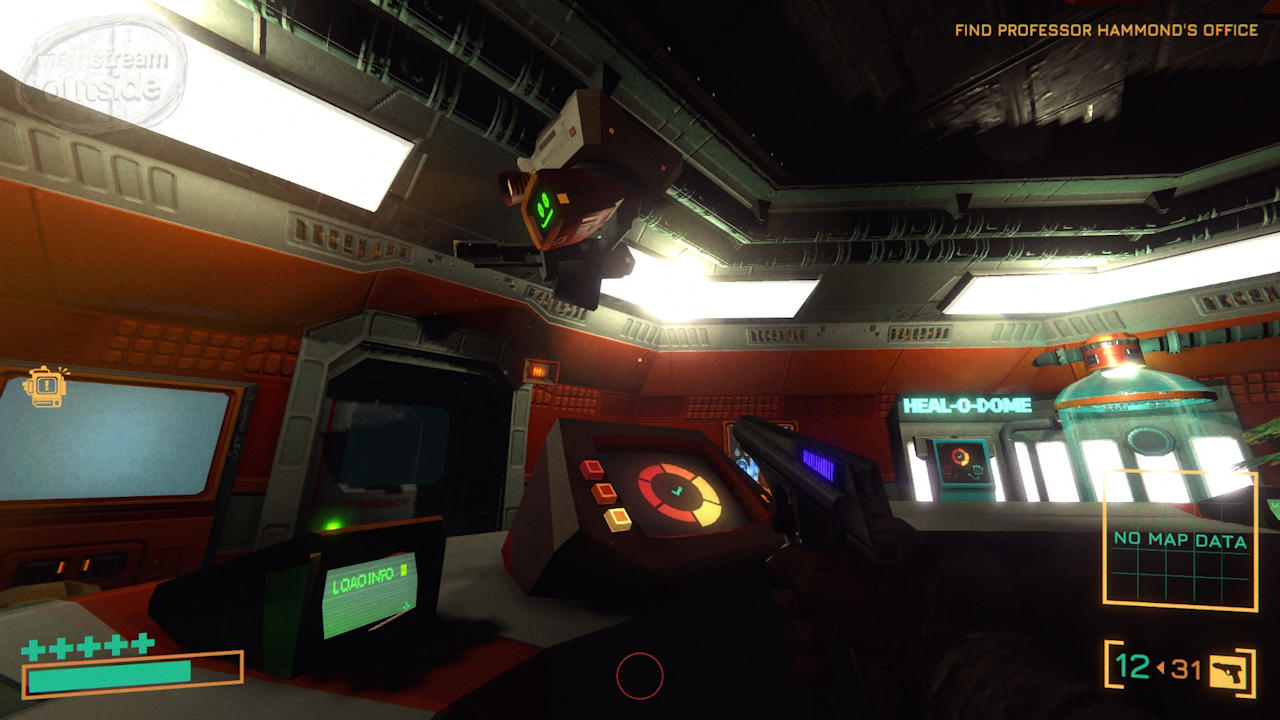
At its core, Aurora 5 is the kind of space station you'd find in any respectable '60s or '70s sci-fi script. Think warm earth tones, embarrassingly geometric carpets, brown or red fabric and leather seating, satirical billboards and neon signs in the vein of Fallout, chunky CRT screens, and surveillance cameras with monitor faces that look like emojis. The occasionally comedic charm disguises the fact that we've seen much of this before—or at least ought to have.
A typical RetroSpace area, complete with a "Stone Age" terminal and a surveillance camera that's currently smiling.
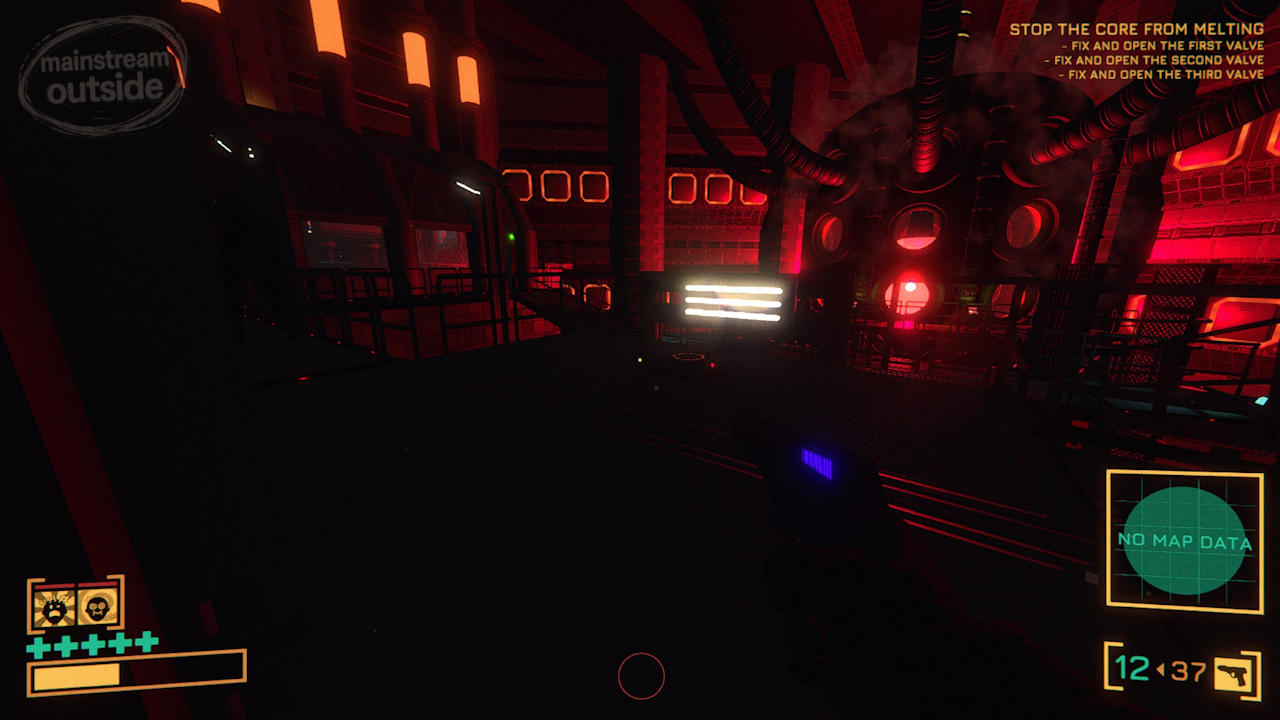
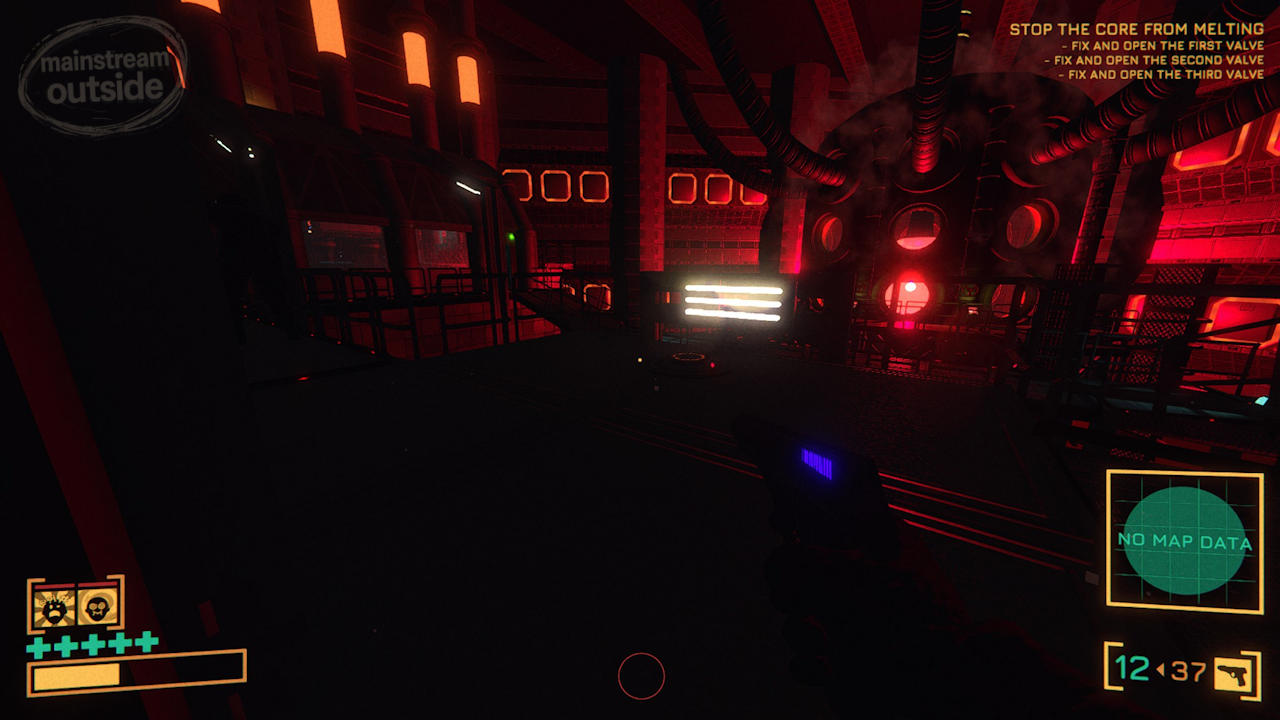
Not every part of the station has that dusty living-room vibe, though. It's frequently disrupted anyway by bloody drag marks, heads exploded against walls or heavily gnawed corpses, but the technical areas provide an even stronger contrast. One highlight is the station's core, drenched in an almost hellish atmosphere. It looks like an oversized Victorian diving helmet sitting inside a gigantic reddish hall with its own separate control room. Genuinely creepy (see the screenshot below).
Aurora 5's core is an infernal sight. The freestanding steel framework and grated walkways also evoke early diving chambers and industrial submarine technology from around 1900.
A station that lets you experiment
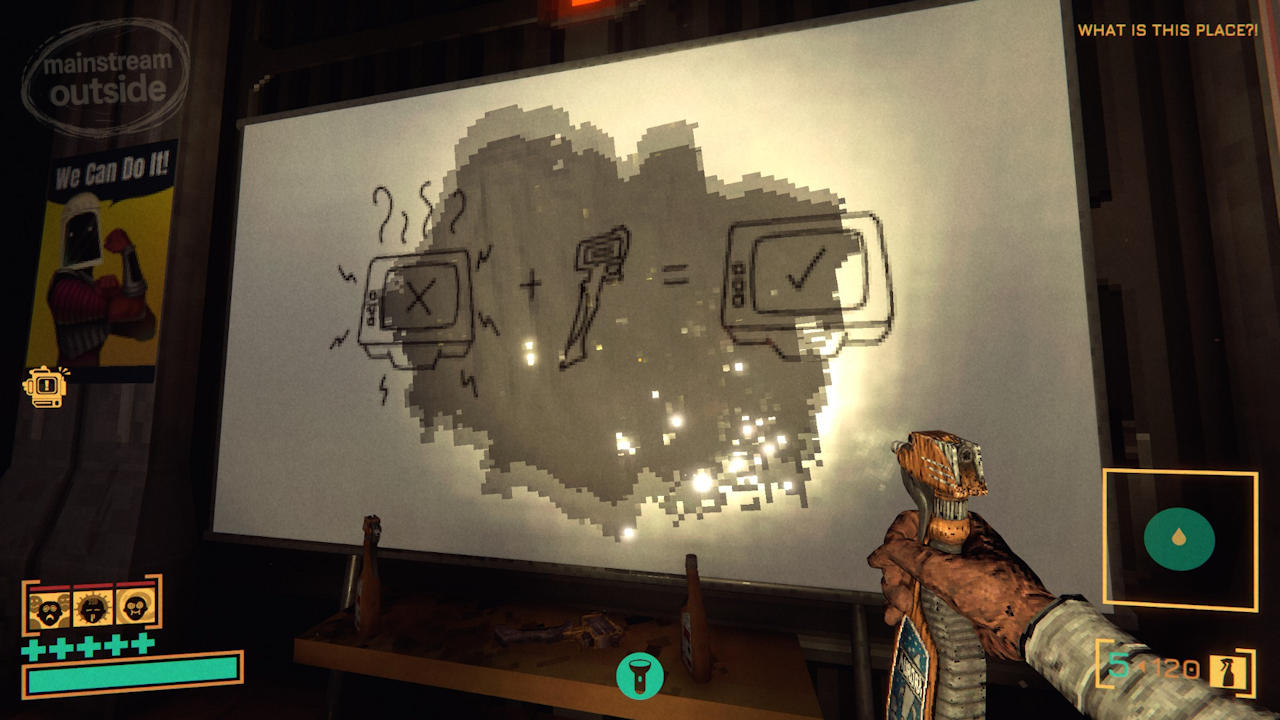
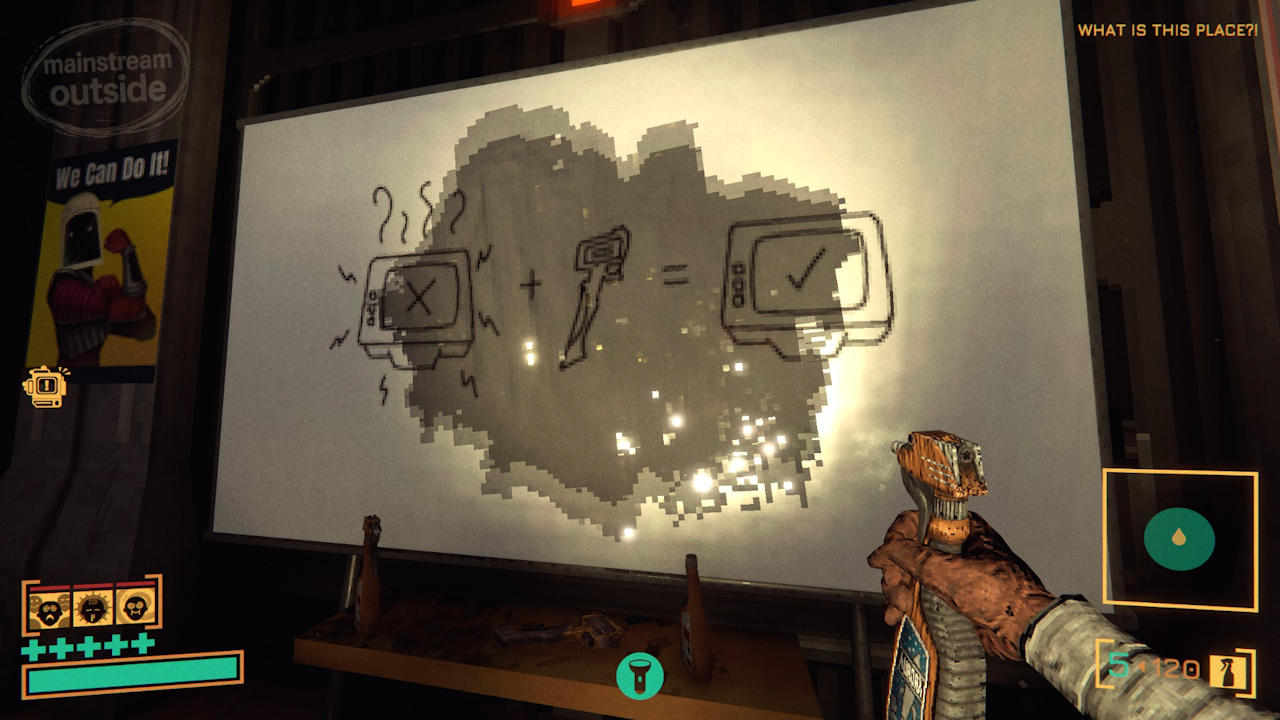
Even more importantly, The Wild Gentlemen have done a good job with the level design. Plenty of objects are interactive: You can turn faucets on and off; use toilets (and activate a toilet disco if the mood strikes); clean floors, walls or objects to uncover clues; connect power sources to devices using conductive cleaning fluid or fry enemies with electrified puddles; smash windows and jump through them; hack door locks via a minigame; and even stack crates into makeshift towers to reach higher places.
The universal cleaner makes short work of grime—and usually rewards your cleanliness with a clue. Here, it reveals how to "switch on" inactive terminals.
And that's still not everything. All that level-design clutter wasn't simply dumped around at random, either. It's assembled in ways that make traversal both challenging and worth exploring. You'll crawl and jump around bulky pipes, fight your way through dark and narrow stairwells or explore branching ventilation shafts where you can smash through grates into the rooms below. That last trick also has tactical uses against enemies ("Surprise!", "Hey, who's shooting me from where?").
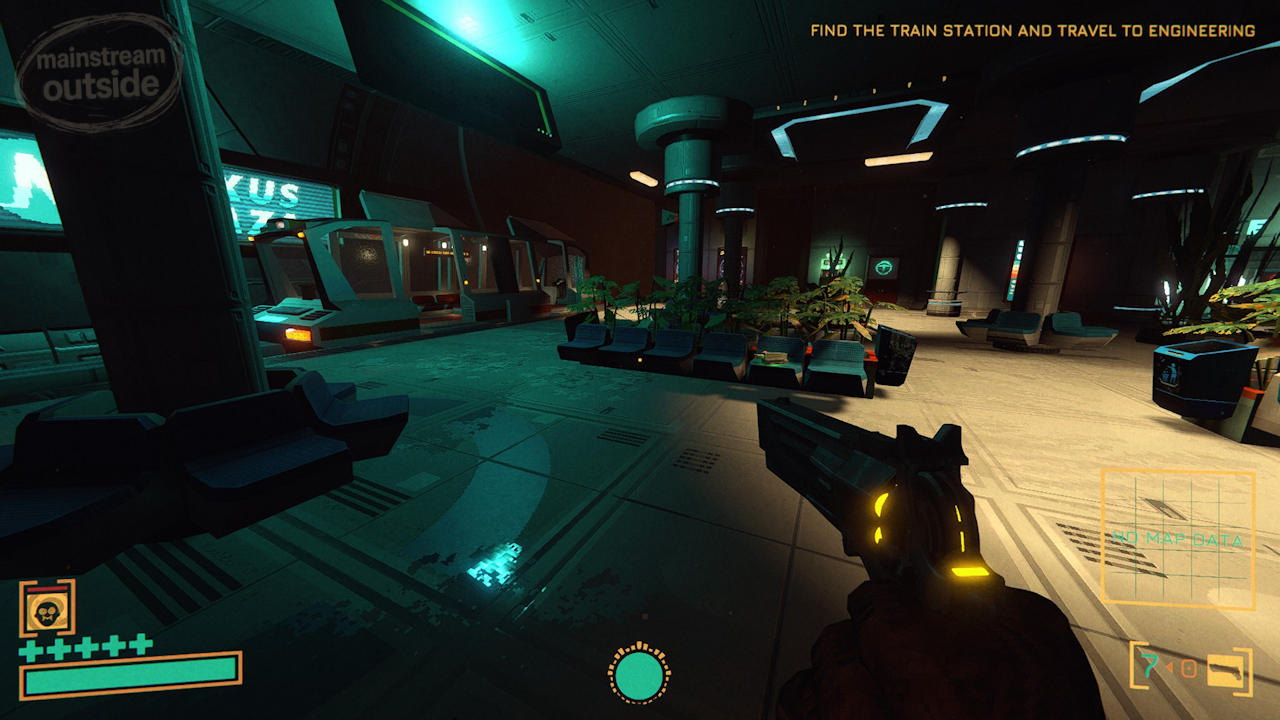
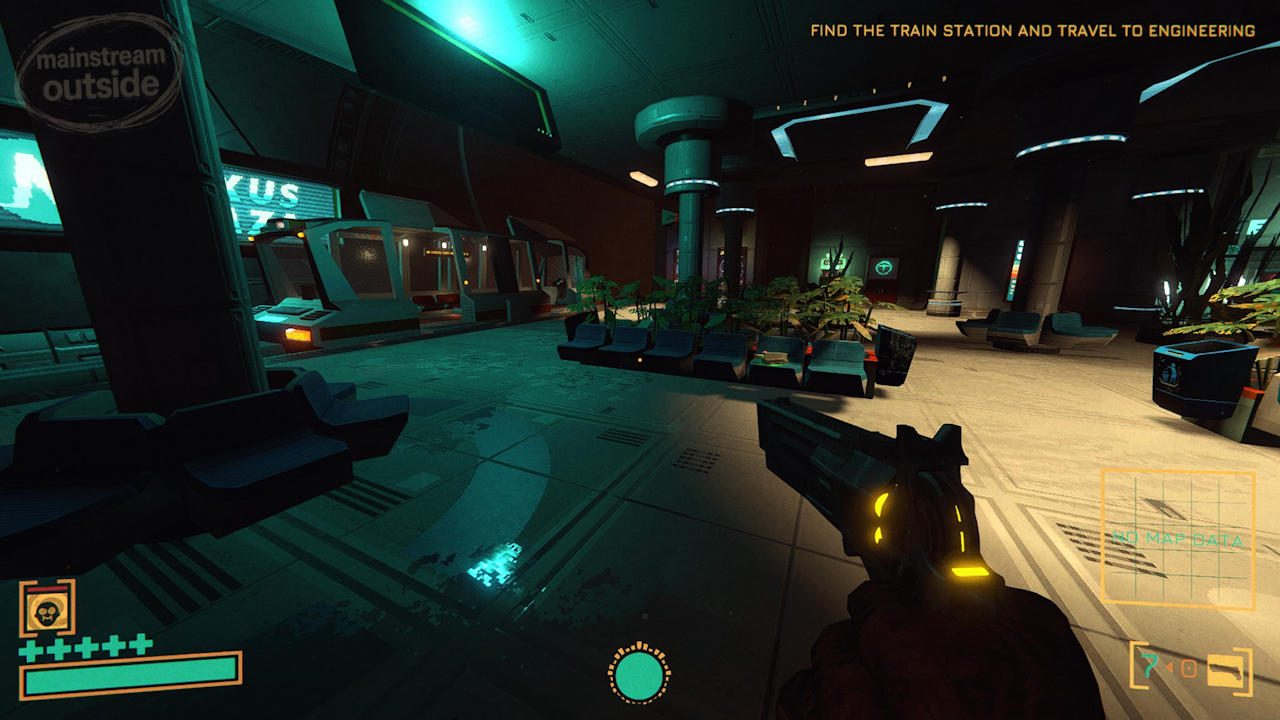
And finally, there's one neat little gimmick: the Aurora Metro. From a certain point onward, you can use the subway to travel between RetroSpace's individual sections. Your destination is selected via a terminal inside the train. It makes sense, too, because even areas you've finished from a story perspective can still hide secrets. Not every door opens on your first visit, either.
The stations always look the same, but they're beautiful. The retrofuturistic subway train is visible in the back left.
As a gamer of somewhat older vintage—one who nearly played the '80s and '90s into oblivion—I absolutely love the station design. I think it's great that modern games can sometimes compete with movies and create ever more believable worlds. It's just that many of them barely let me play with those worlds anymore. Aurora 5 does. And it does so more than well enough that RetroSpace doesn't live or die by its story.
Combat: System Shock-level, except that was 27 years ago
By now it should be obvious that RetroSpace isn't just a shooting gallery, even though it lacks the RPG elements of System Shock 2. It compensates a little with so-called Mutamods, which you "pull" from vending machines using the currency scattered around the station. "Mutamods" is admittedly a grand name for a relatively small selection of upgrades, though they can have a meaningful impact, especially in combat. Among them:
- Unicellular: Creates a clone of yourself to keep enemies busy
- Bat Hearing: Lets you see through walls using ultrasound
- Moth’s Light: Light sources recharge energy-dependent items, such as your flashlight
- Rhino Body: Greater physical resistance and increased melee damage
The roaming creatures—including insect-like humanoids, giant black spiders, anthropomorphic wild boars, hulking robots with monitor faces, and life-sized creepy dolls—mostly get acquainted with the stopping power of your firearms. Flare gun, tech shotgun, sci-fi handgun, "Magnum" revolver: The arsenal isn't exactly full of surprises. The melee weapons are similarly conventional, but whenever a massive wrench dances across somebody's skull, satisfaction tends to follow.
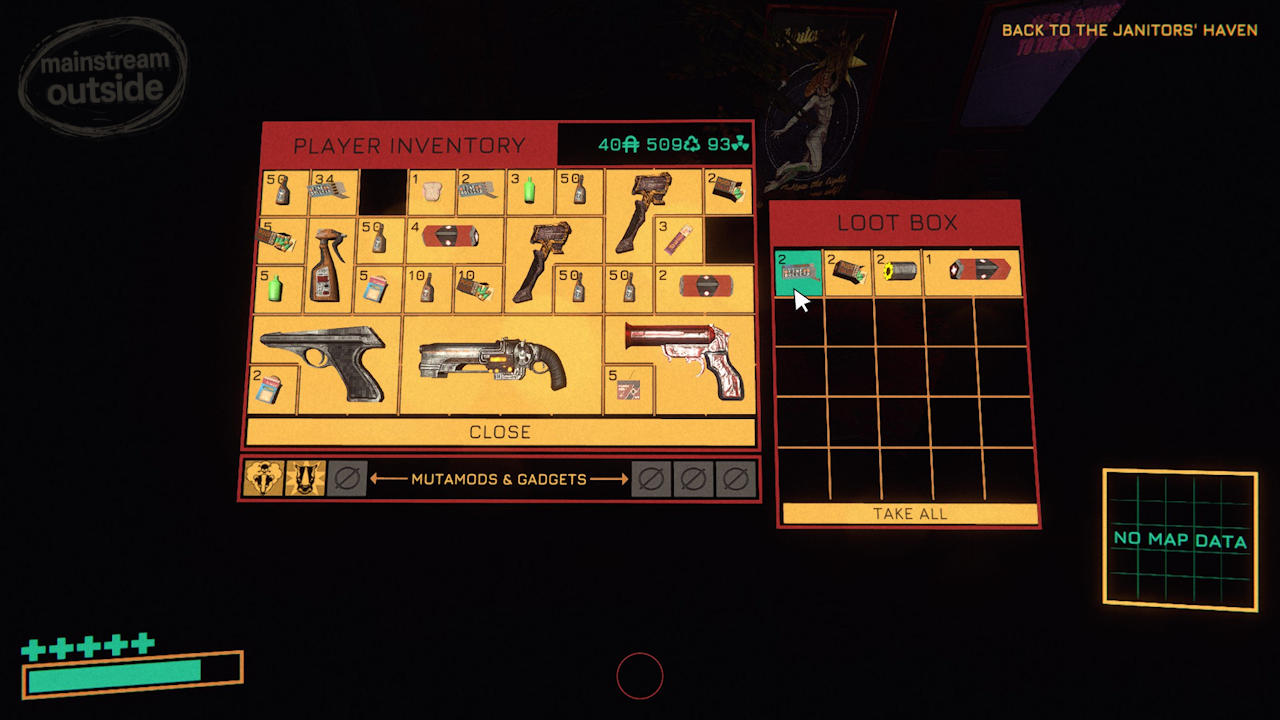
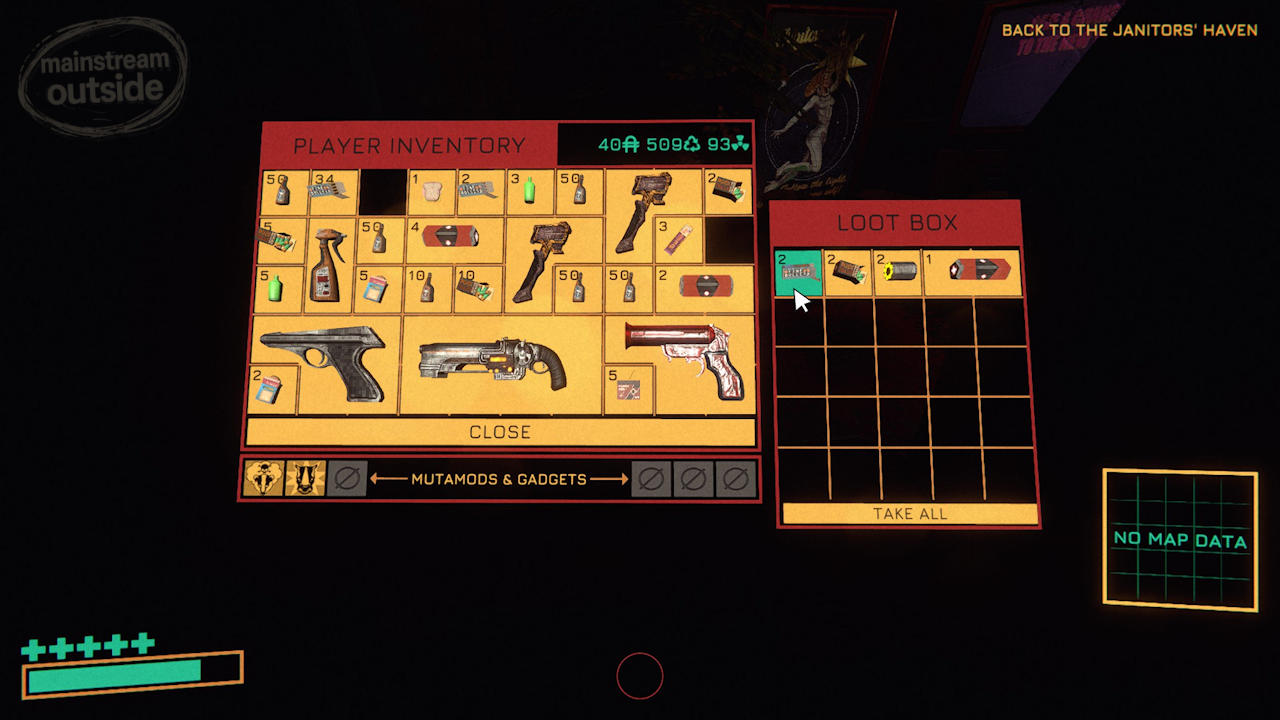
The drag-and-drop inventory works like System Shock 2's Tetris-style grid and has room for several weapons and healing items.
Depending on which of the four difficulty settings you choose, RetroSpace's combat ranges from challenging to very tough. The higher the difficulty, the stronger the enemies and the scarcer the ammunition and medkits. Boosts and other healing items also become more expensive. On the hardest setting, "Russ Kurtell" (yes, the devs know "The Thing"), you even get just five lives. Lose them all and it's back to the very beginning.
RetroSpace, the Reference Machine
Speaking of Russ Kurtell: RetroSpace underlines its retro credentials with several funny references, and a few of them particularly stood out to me.
• Cosmi-Cola: The name of this "healing potion" is probably a nod to Cosmi Corporation, an American software company founded in 1982. During the '80s, it was best known for its low-budget games. One of Cosmi's most prominent developers was Paul Norman, creator of the technically impressive action game Forbidden Forest (1983), among others.
• Logan’s Beer: Given RetroSpace's sci-fi theme, the name is most likely a reference to "Logan’s Run". Released all the way back in 1976, the movie depicts a futuristic affluent society that secretly executes all of its members once they reach the age of 30. Reviews were mixed at the time, but the film has since become a cult classic of dystopian cinema.
Speaking of Russ Kurtell: RetroSpace underlines its retro credentials with several funny references, and a few of them particularly stood out to me.
• Cosmi-Cola: The name of this "healing potion" is probably a nod to Cosmi Corporation, an American software company founded in 1982. During the '80s, it was best known for its low-budget games. One of Cosmi's most prominent developers was Paul Norman, creator of the technically impressive action game Forbidden Forest (1983), among others.
• Logan’s Beer: Given RetroSpace's sci-fi theme, the name is most likely a reference to "Logan’s Run". Released all the way back in 1976, the movie depicts a futuristic affluent society that secretly executes all of its members once they reach the age of 30. Reviews were mixed at the time, but the film has since become a cult classic of dystopian cinema.
Better to shoot than sneak
Regardless of the difficulty setting, confrontations are fairly straightforward. Spiders provide a little variety because they sometimes lazily hang around in their webs, allowing you to sneak past them. You can also observe and avoid other baddies thanks to your ability to peek around walls or objects. But since most of them are such a nuisance, stealth rarely feels like the better option.
Once an attacker spots you—which sometimes happens implausibly quickly—it practically zips toward you on a string. I never saw anything resembling tactics from any enemy during my review playthrough; they all seem to operate on a simple "seek and destroy" principle.
The enemy AI's shortcomings also become apparent when something as basic as a table turns into a serious obstacle. Occasionally, creatures didn't seem to know what they were supposed to do at all, simply standing motionless in my line of fire. On the plus side: Just like in those crusty old '90s classics, enemies will happily fight each other.
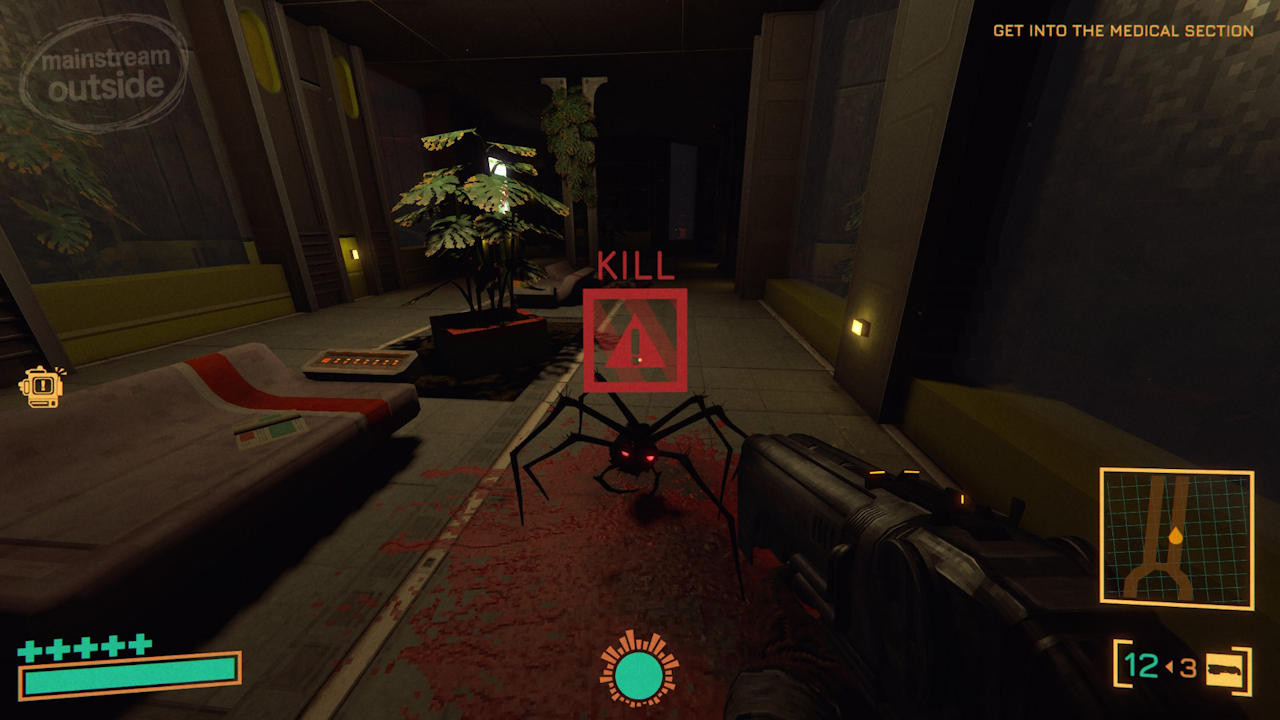
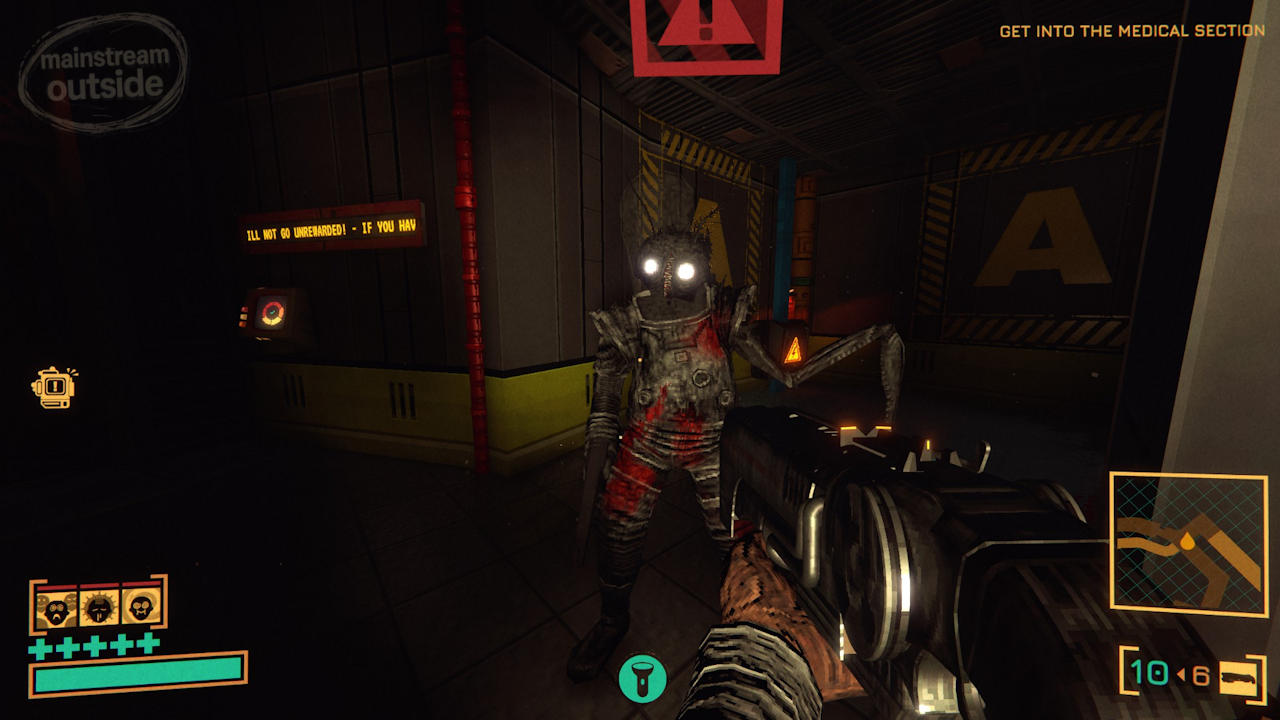
Spiders (left) only become dangerous in groups. The "insect man" on the right, meanwhile, is always a threat.
When you bite the dust, you respawn shortly afterward in a nearby Heal-O-Dome. These are vertical glass pods where genetic engineering reconstructs you. Except—and I absolutely love this—it doesn't always reconstruct you correctly.
Your new self might emerge with a cold, for example, causing the occasional sneeze to give away your position. Or you might end up with an absolutely glorious genetic defect that makes you swear uncontrollably from time to time ("Sh❤️t, sh❤️t!", "This f❤️cking sh❤️t!"). Seriously? I voluntarily kept that defect for part of my playthrough because I loved it so much.
You can get this wonderful nonsense cured, of course. For a price. Genetic defects can still be punishing, though, because you won't always have enough cash in your pocket. The developers also tweak the save system: You can save at any time, but dying may overwrite a quick save you made shortly beforehand. Presumably, that's meant to stop you from making things quite as easy for yourself as you could in RetroSpace's ancient inspirations.
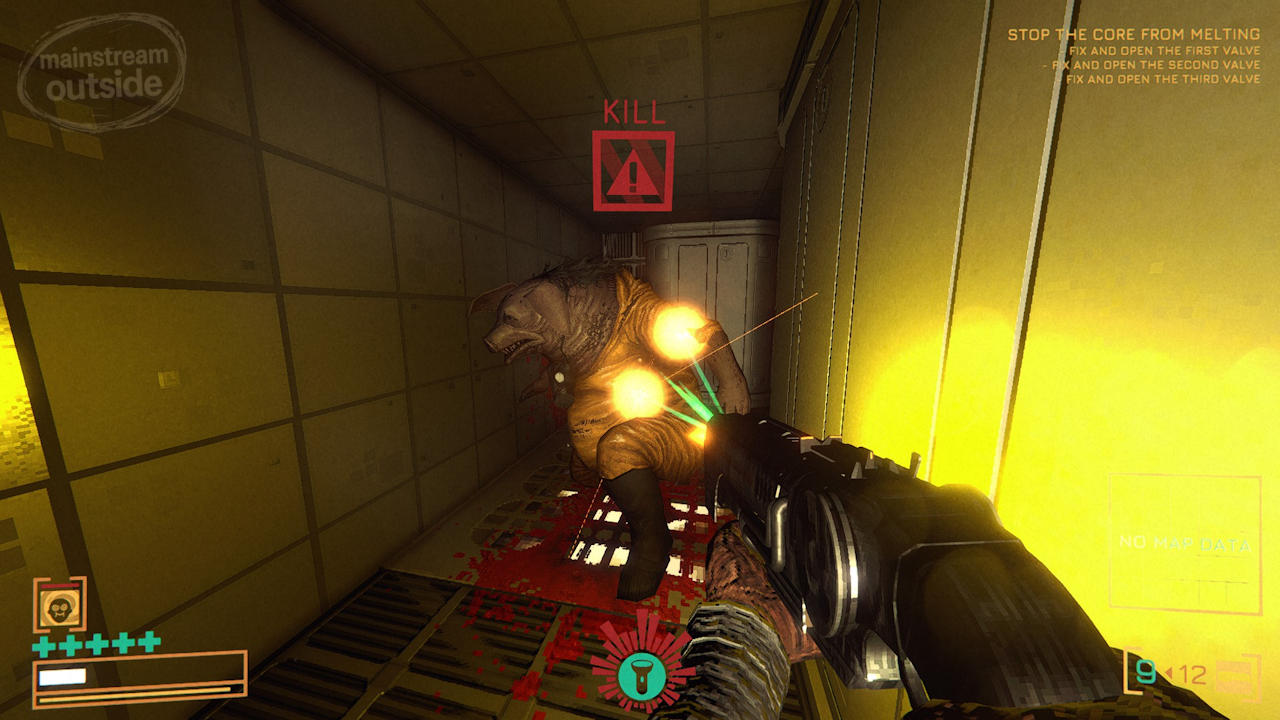
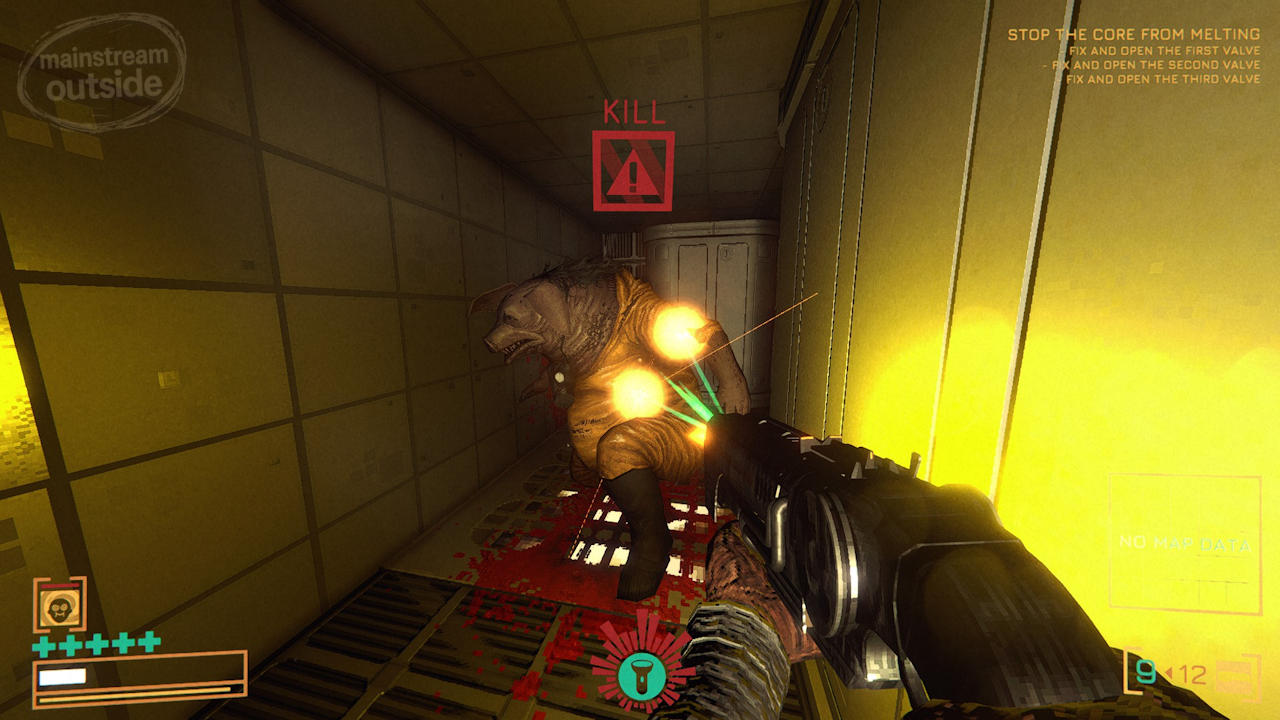
Some of RetroSpace's fights take place in very tight spaces. When a hulking boar-man like this one shows up, the shotgun is your best friend.
To sum it up, the gunfights didn't exactly blow me away; more modern gunplay would certainly have made them more enjoyable. But I don't believe The Wild Gentlemen simply couldn't do better. More likely, the team deliberately wanted this kind of retro shooting and clobbering for old times' sake. Either way, the simplistic encounters don't really ruin the fun. The developers have poured so much of that into RetroSpace that there's still more than enough left over.
Tech: RetroSpace gives the CPU more of a workout
At first glance, RetroSpace looks far less demanding than it actually is under the hood. Up close in particular, the game deliberately shoves coarse, sometimes almost PS1-like pixel textures in your face. From a little farther away, though, the style works surprisingly well.
Not least because The Wild Gentlemen combine the retro aesthetic with modern lighting, high-quality shadows and dense particle effects. RetroSpace can look especially impressive in dark technical areas or during larger battles. Those are also the moments when it becomes clear that performance still has room for improvement.
In my 20-second benchmark sequence featuring multiple enemies, explosions and plenty of effects, an RTX 3060 averaged 69.8 FPS at 1080p and maximum settings. The 1% low dropped to 45.8 FPS, however, while the 95th-percentile frametime reached 16.4 milliseconds. In practice, this mainly shows up as brief dips whenever the game has to process lots of effects and physics objects at once.
Interestingly, the GPU isn't constantly maxed out during these scenes. Combined with the relatively low VRAM usage of 2.49 GB, that points more toward a CPU or engine bottleneck. Explosions in particular sometimes send half the room flying.
That's not to say RetroSpace is unplayable or generally stuttery. Most of the time, it runs perfectly decently on our increasingly seasoned review system. Considering what you're actually seeing on screen, though, performance should be more consistent—especially during the effect-heavy moments when the game demands the most attention from you.
Verdict: One of 2026's most enjoyable games—Flaws and All
RetroSpace reminded me once again why I miss classic immersive sims. Not because everything was better back then, and certainly not because enemies 25 years ago were particularly intelligent when running into tables. It's because those games gave me a world and then basically said: "Go on. Try stuff. See what happens."
That's exactly where RetroSpace excels. Aurora 5 isn't merely a pretty backdrop, but a playground full of little systems, shortcuts, secrets and possibilities. I can smash windows, crawl through ventilation shafts, roast enemies with electrified cleaning fluid, stack crates, hack terminals or have myself reconstructed after a failed firefight—complete with a genetic defect that makes me swear involuntarily. Those are the things that stayed with me far more than the actual story.
Because no, the whole package isn't perfect. The plot takes too long to become genuinely interesting, the enemy AI feels like it came straight out of the '90s as well, and the gunplay could have used a little more of the present day. The Wild Gentlemen also have some technical work left to do, because larger battles hit performance harder than the visuals would suggest.
But you know what? After around 20 hours, I was surprisingly fine with all of that. RetroSpace packs so much atmosphere, joy of discovery and playful nonsense into a single station that its weaknesses may scuff the fun around the edges, but they never swallow it whole. And at just $20, you're getting a remarkable amount of game for your money.
If you grew up with immersive sims—and System Shock 2 in particular—you'll probably feel at home aboard the Aurora almost immediately. Assuming "home" is a place where mutated boar-men run through the hallways. Just as the headline says: For fans of the old Looking Glass school, RetroSpace is genuinely a must-buy in my book.


Read next:
Comments