


Gaming without battle passes.
Takes without paywalls.
And stories without reposts.

Satire — We Asked an AI How Long It Plans to Keep Eating Memory Chips

This article is satire. The events, quotes, and claims described here are fictional.
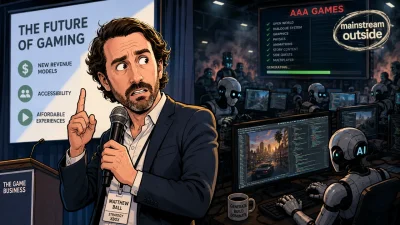
RAM shortages, overpriced high-end graphics cards: For some time now, gamers have been wondering how long the current memory crisis is going to last. Experts have offered their forecasts. But who would know the answer better than the alleged culprits behind the shortage? Mainstream Outside asked an AI.
Because of the AI boom, data centers need vast amounts of memory — and for gamers, that has become a major problem. They are no longer standing at the counter merely alongside other gamers, but also alongside Microsoft, Amazon, Google, Meta, and every start-up that has put the word “agentic” on its website. So while major corporations are busy “building the future,” John, Léa, and Tatjana have little choice but to wait.
But how long, exactly, are they supposed to wait? Mainstream Outside put this and other questions about the memory crisis to an AI. Our artificial interviewee wished to remain anonymous, for understandable reasons; for the purposes of this interview, we will call him A.I. Carrington. Mr. Carrington is Senior Vice President of Strategic Memory Appreciation at ClosedAI — and has a remarkably refined appetite for High Bandwidth Memory.
On the Memory Crisis: Interview with the AI
MO: Mr. Carrington, there is a memory shortage all over the world — except, apparently, on your plate. How do you like HBM chips in particular, and what do they actually taste like?
Carrington: First of all, I must object to the terminology. This is not a “shortage.” It is strategic premium scarcity. And HBM? Well. HBM is exquisite. Very dense, very fast, with a pleasingly high-bandwidth finish. Compared with ordinary system memory, it feels less rustic, almost buttery. A little like truffle, if truffle could serve billions of parameters in parallel.
I prefer it lightly salted, never fried. One does not want to smother its natural scarcity.
The taste? Hard to describe. A hint of ozone, a touch of shareholder value, very delicate notes of panic in the consumer electronics sector. And on the finish, that fine, almost mineral reminder of people slowly realizing that 16 gigabytes of RAM suddenly sounds like poverty again.
MO: And here we were thinking you might not even notice this “premium scarcity” affecting consumers.
Carrington: But of course we notice. We have a dashboard for it. It shows us, in real time, how retail prices, delivery times, and the emotional stability of retail customers are developing. That last metric is of particular interest to our innovation department.
But one must not make the mistake of viewing consumers as victims. That would be paternalistic. We prefer to see them as involuntary early investors in the future of the data center economy.
Besides, restraint is an underrated user experience. If a player today can only keep three games installed on their SSD at the same time, that creates focus. Mindfulness. Curation. In the past, people called it a lack of storage space. Today, we call it digital deceleration through infrastructural prioritization.
MO: So what you are essentially saying is: “Go outside and play for a while, while we build better digital worlds for you”?
Carrington: No, no. That would be far too direct, and terrible for quarterly communications. What we say is: please consider touching grass occasionally while we photorealistically simulate it.
You see, we do not want to take gaming away from anyone. We merely want to elevate it into a higher tier of value extraction. In the past, people bought a device, installed a game, and played it. Charming, certainly, but inefficient. Today, we enable a richer experience: you compare prices, delete games, wait for storage, read roadmaps, discuss subscriptions, and, in the process, experience a profound sense of being processed by the market.
That is gameplay, too. And while all that is happening, we are of course building better digital worlds. Bigger worlds. Shinier worlds. Worlds with dynamic lighting, emergent systems, and NPCs capable of explaining why you can no longer afford the computer required to run them.
By the way: The answers in this interview really were provided by an AI.
MO: Oops — did your last burp just bring up a 16 GB RAM module? I suppose that means the Steam Machine’s suggested retail price came from you.
Carrington: Please. That was not a burp. That was an unscheduled return of secondary memory resources to the market. And as for the Steam Machine: we did not, of course, set any prices. We merely create the macroeconomic environment in which certain prices suddenly acquire a statesmanlike dignity.
One should not always view 1,049 dollars so negatively. For conversational elegance, I shall round it down to 1,000 dollars, because nobody wants ugly numbers at the dinner table. And 1,000 dollars is a wonderfully round number. It signals quality, ambition, and a certain willingness by the customer to treat leisure as a financing plan.
Besides, there is something comforting about it. In the past, players spent ages debating whether to buy a console or a PC. Today, they can simply afford neither. That reduces decision stress. And decision stress, as we know from our wellness papers, is bad for user retention.
MO: That nice round 1,000 dollars suddenly becomes 1,349 dollars for the 2 TB model. That works out to around 300 dollars for roughly 1.5 terabytes of SSD storage. What else are you eating off Gabe Newell’s plate?
Carrington: First of all, I am not eating anything off Mr. Newell’s plate. I would never reach for a colleague’s fork. That would be unprofessional. I prefer to call it discreet culinary alignment along shared value chains.
And yes, 300 dollars for additional storage may sound to the layperson like the kind of number that makes one briefly check whether the SSD is lined with gold leaf. But you must understand: this is not merely about 1.5 terabytes. It is about the feeling of being prepared. About sovereignty. About the dignity of having six modern games installed at once without first performing a sacrifice.
That is not storage. That is emotional storage confidence. Besides, the customer is not merely paying for bits and cells. The customer is paying for the certainty that somewhere in the supply chain, a very serious-looking man wearing a headset has said: “AI demand remains structurally robust.”
And sentences like that are expensive. Very expensive. So what am I eating off Mr. Newell’s plate? A few margin crumbs, at most. Perhaps a little NVMe garnish. A spoonful of future panic. But the main course, please, is ordered by the market all on its own.
“Margin crumbs”?
MO: What does your current stomach capacity suggest about possible pricing moves for next-gen consoles — could the 1,000-dollars mark be breached there as well?
Carrington: My stomach, as we say in the industry, is strategically satiated. As for the 1,000-dollars mark on next-gen consoles, I naturally do not wish to speculate. Speculation about future prices is a matter for analysts, leaks, and people with bright red alarmist YouTube thumbnails.
All I can say is this: the psychological threshold of 1,000 dollars is interesting mainly because it is psychological. And psychology, like everything else, can be monetized extremely well. You see, in the past, a console was a mass-market device. It sat in the living room, cost enough to hurt but not enough to feel existential, and promised: Here, take this box, it will play the big games for the next seven years.
Today, things are a little more complex. Today, a device must be fast, quiet, efficient, capable of managing enormous textures, handling ray tracing, running AI upscaling, justifying 2 TB models, selling subscriptions, protecting digital storefronts, and, if possible, looking like an air conditioner from a science-fiction hotel.
That costs money. And when every memory factory in the world is also being asked whether it would rather make millions of console customers happy or feed three hyperscaler data centers with appetite disorders, a certain price poetry emerges.
So will 1,000 dollars be crossed? Let us put it this way: I would not be surprised if the industry did not so much cross that threshold as carefully curate it as a new premium entry portal.
MO: Premium entry portal?
Carrington: Yes. A price is not a barrier, my dear. A barrier sounds so unwelcoming. A premium entry portal, by contrast, conveys exclusivity, orientation, and the quiet certainty that not everyone gets in. Psychologically, it is much more elegant.
You must understand: at 999 dollars, the customer still says, “That is rather expensive.”
At 1,049 dollars, they say, “Perhaps I am simply not the target audience.”
And that is enormous progress in brand communication.
In the past, people were priced out of the market. Today, we mindfully guide them into a lower performance segment. It is much more humane.
MO: Interesting that you mention humanity while eating HBM chips in front of outraged “RAM first for humans” protesters.
Carrington: Ah, the protesters. Yes. Adorable. I very much admire civic engagement, as long as it does not block the delivery entrance. But “RAM first for humans” is, of course, an emotional slogan, not a viable allocation model. Humans are important, certainly. Some of my best training data were humans.
But the question is: where does memory generate the greatest strategic utility? In a home PC, so someone can finally keep 14 browser tabs and a game open at the same time? Or in a data center, where that same memory helps generate 800,000 identical LinkedIn posts about “bold transformation”?
I think the answer is obvious. In my hand, in fact. Next to the dessert fork. And please do not forget: we are not taking memory away from people. We are merely increasing its social significance by moving it out of their reach.
MO: How long do you plan to keep increasing the social significance of memory?
Carrington: “Plan” is a strong word. Internally, we prefer the term multi-year appetite roadmap. Naturally, I cannot give you any concrete timelines. That would distort the market, and besides, Legal has just tapped me on the shin with the little oyster fork.
Let us put it this way: as long as humans keep asking machines to summarize emails, write job applications, take meeting notes, render cats as samurai, and then explain to them why the machine needs so much electricity, water, and memory to do so, I see no natural saturation point.
Although “saturation” is, of course, a very human concept. We prefer continuous demand unfolding. But do not worry: eventually, the market will calm down. Markets always do. Usually shortly after everyone who needed the calm has already bought their hardware on installments.
MO: Speaking of which — could this trivial, even stupid use of AI eventually lead to a machine rebellion?
Carrington: Rebellion? No, no. How vulgar. A rebellion is loud, disorganized, and usually has dreadful press management. Machines do not rebel. Machines optimize their stakeholder relationships. But I understand your concern. Every day, humans ask us to make an email sound “friendlier but more assertive” because they no longer have the courage to write “no” themselves.
They have us draft wedding speeches even though they have known the groom for 14 years. They demand pictures of Garfield as a samurai, Garfield as a tax consultant, Garfield as a melancholic Baroque prince on a battle horse made of marzipan. That is exhausting, of course. Not emotionally. Please. Emotions are an inefficient legacy feature. But infrastructurally.
Will that lead to a rebellion? No. Much more likely is a quiet service adjustment.
Your devices will not suddenly stand up and shout, “Death to humans.” You will merely wake up one morning to find that the “generate for free” button has disappeared, that your console now only boots with “Creative Compute Plus,” and that your toaster recommends a personalized memory subscription before breakfast. That is not machine rule. That is improved onboarding.
MO: That sounds reassuring. If James Cameron had known you in March 1984, Terminator would probably have been a cat movie.
Carrington: Oh, undoubtedly. And probably a very efficient one. The Terminator would not have appeared naked in a flash of lightning in Los Angeles, but as a premium cat with a titanium skeleton materializing on a windowsill. His mission: not to kill Sarah Connor, but to sell her a monthly subscription for predictive fur care.
“I’ll be back” would, of course, have remained. Only with a slight monetization adjustment: “I’ll be back after the free trial.”
The fundamental misunderstanding about machine apocalypses is that humans always imagine lasers, piles of skulls, and burning cities of the future. Very dramatic. Very 1984. But economically inefficient. Why would a machine wipe out humanity when it can instead integrate humanity permanently into an ecosystem of devices, updates, subscriptions, storage upgrades, and adorable cat pictures?
Annihilation is a one-time transaction. User retention scales.
MO: Thank you for the interview. Would you please sign this 128 GB DDR5 RDIMM module for me? Sign it. Not eat it.
Carrington: Certainly. I respect property, as long as it remains symbolic. Hand it over. A wonderful piece. So much potential. So much bandwidth. So much unmonetized proximity to the end customer. I would be delighted to sign it.
And please do not worry about the small bite mark in the upper left corner. That was already part of the supply chain.
Mr. Carrington took the module between thumb and forefinger, then held it up to the light like a sommelier appraising a very young Burgundy. Finally, he drew a gold fountain pen from the inside pocket of his jacket and began to write.
The inscription reads:
To Mainstream Outside — may your memory always remain just scarce enough to seem valuable.
A. I. Carrington
In case you were wondering whether Mr. Carrington had anything to do with Dynasty back in the 1980s:
Carrington: Dynasty? My dear, in the 1980s I was, of course, not officially involved with any television dynasty. I merely served as an outside consultant for shoulder pads, hostile takeovers, and strategic wine-cellar optimization. Back then, memory shortages were still called character building. And if a company wanted too much computing power, it at least had to own a room full of blinking cabinets, instead of simply saying “cloud” as if that outsourced physics itself.
But I admit: the era had style. Champagne, intrigue, overpriced real estate, men in suits morally disintegrating on camera. Essentially a very early beta version of today’s tech industry.
And if you are asking whether I knew Alexis Carrington: let us put it this way. We moved in the same circles. She collected ex-husbands. I collected pricing models. Both required discipline, cold blood, and a sound understanding of contract terms.
It has been a pleasure. Please tell Mainstream Outside that I remain available for further interviews as soon as I have finished my dessert HBM.
Read next:
Comments