Gaming without battle passes.
Takes without paywalls.
And stories without reposts.

Steam, the Game Landfill: Why Valve Sells So Much Junk

Have you ever found yourself trawling through the Steam store and thinking, “Man, what a dump. When is an actual professional game going to show up?” Well, Valve doesn’t make this garbage itself. But the company has built a system in which the endless flood of trash is entirely predictable—and not much of a business problem for Valve. Let me explain why.
If Steam were a person with a serious belching problem, some deeply unpleasant things would come up. 🙂 Yes, Valve’s platform is packed to the rafters with “garbage.” That’s how plenty of users describe it, anyway—and they’re not entirely wrong.
Steam piles amateurish games into its bargain bins by the truckload. Some even have gameplay trailers recorded with the game engine’s editor interface still visible. Want an example? Click here. Releasing something like that is roughly equivalent to Ferrari letting me enter a Formula 1 race and telling me I can get my driver’s license later. As long as I know what the white flag means: congratulations, every other driver has retired.
Seriously, though: Steam Direct has further democratized game distribution, but that doesn’t automatically make it a noble cause. It’s also a business model in which Valve throws the doors wide open and passes the cost of sorting everything out to players, developers, and algorithms.
Put differently, the garbage isn’t necessarily the goal. It’s the accepted collateral damage of a system designed to let as many releases through as possible and have algorithms sort them out afterward. Steam’s deluge of games reminds me of business models that hustlers—and outright crooks—have used to make money in other industries.
Steam Direct’s tiny barrier to entry
To understand the thinking behind Steam’s “waste-management business,” we need to take a quick look at the root of the problem. I’m talking, of course, about Steam Direct. Its launch on June 13, 2017 marked the beginning of Steam’s final transformation into a landfill. Even back then, skeptical journalists—including writers at Wired and Kotaku—painted a remarkably accurate picture of the shovelware-infested Steam you and I know today.
One of the biggest criticisms was its incredibly low barrier to entry, which essentially invites every mediocre garage developer to put their work on Steam. Valve only places these tiny obstacles in their way:
- The game must work (no shit, Sherlock) and its marketing must accurately represent it
- Plagiarism and hateful or illegal content are prohibited
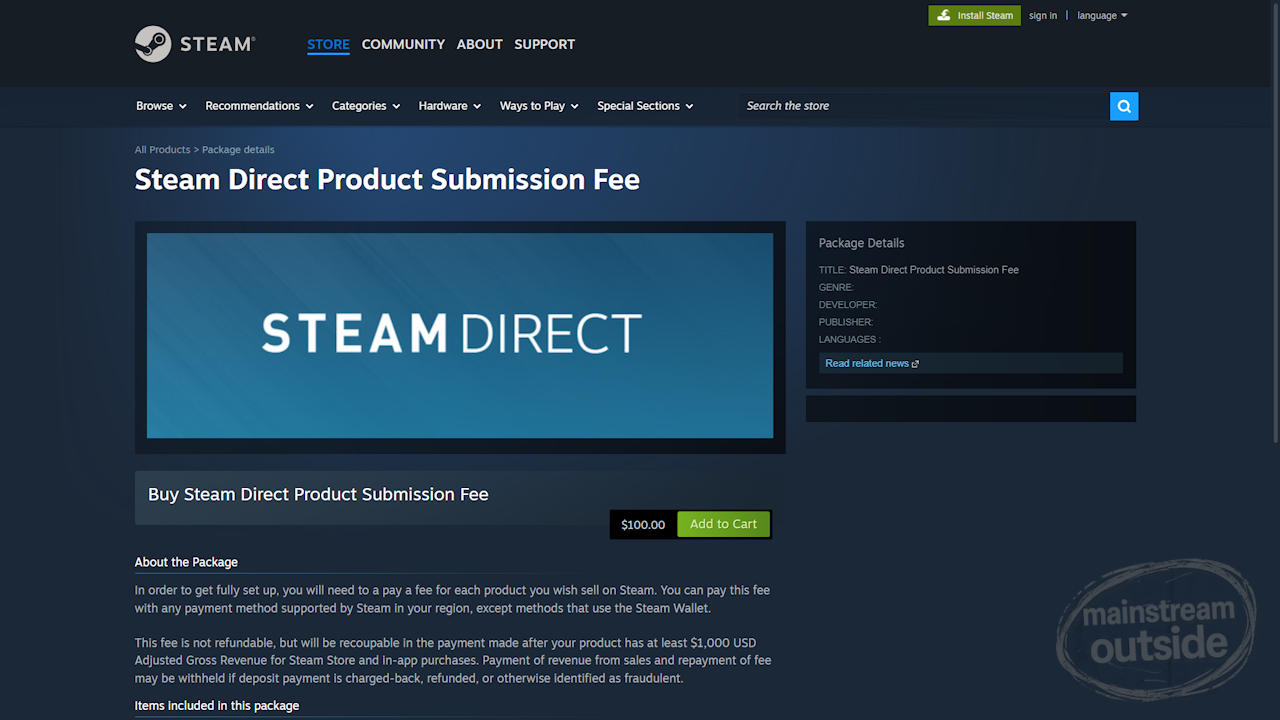
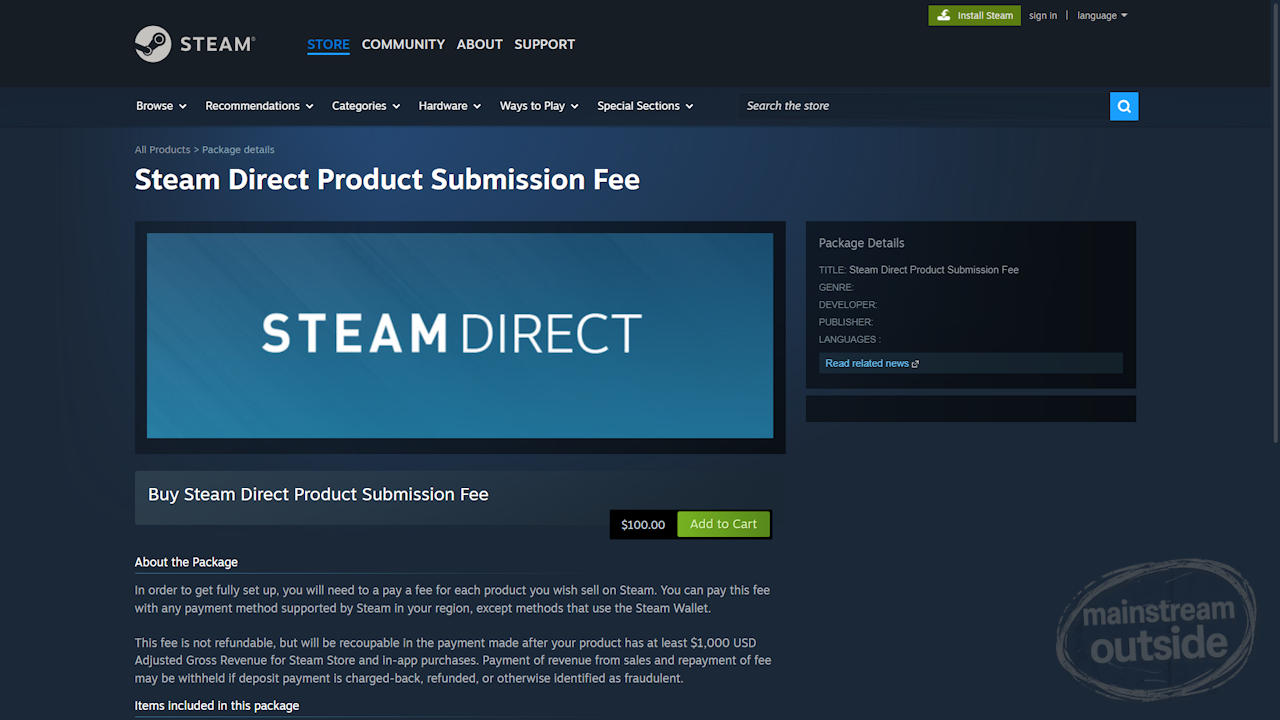
- You have to pay a $100 submission fee
- Valve reviews the store page and submitted build
- A developer’s first releases are subject to a 30-day waiting period after payment
- That’s it
- There’s nothing else
Fancy dumping some garbage onto Steam yourself? As you can see above, it’s about as easy as buying a game.
So, if your project pipeline happens to include a long-distance booger-flicking simulator, a PvP shooter with hangman-doodle graphics, or an IQ test for woodlice, you can almost certainly get it onto Steam. Don’t believe me? Then you haven’t seen Congratulations On Your Purchase yet. There’s more where that came from over here, by the way. And if you think Steam reliably keeps prohibited content off the platform, take a look at the first-person shooter Fascist while you’re there.
On the other hand, Valve’s store still isn’t quite the bargain-basement supermarket of games. Not every Steam game with a $3 or $5 price tag is trash; sometimes it’s the exact opposite. I’m particularly fond of digging through countless tiny indie games and unearthing little gems like Abyss School, Love Love School Days, and Crimson Snow.
But Steam clearly has far too many Congratulations On Your Purchases and The Another Worlds—a tiresome consequence of the idea that even tiny contributions add up. And over time, all those little contributions pile up into a truly impressive heap of manure, as you’re about to see.
What Steam Direct is really about
So Valve pockets a $100 submission fee and effectively says: if your game fails to generate at least $1,000 in adjusted gross revenue, we keep the money. In that case, your $100 is gone. But if your game passes the $1,000 mark, the fee reappears as a credit in a future payment.
That’s what “recoupable” means here. The fee isn’t a conventional deposit you can reclaim whenever you please. It’s only offset once your game reaches a specific revenue threshold. Successful games effectively get the $100 back. Games that stay below the threshold help pay for Valve’s bouncer.
On top of that, Valve takes 30 percent of your revenue up to $10 million. Above $10 million, Valve’s cut drops to 25 percent; above $50 million, Steam takes 20 percent. That’s the hefty price Gabe Newell’s store charges for the chance to be seen on the world’s largest PC game marketplace. The key word is chance, because the algorithms still need to smile upon your game and drop it in front of the right audience.
More revenue shares for comparison:
• The Epic Games Store currently advertises a 100 percent / 0 percent revenue split on the first $1 million in net revenue per product per year. In other words, the developer gets everything and Epic gets nothing. Once a product crosses the $1 million mark, the standard 88 percent / 12 percent model applies.
• Itch.io lets sellers choose for themselves how much of their revenue goes to the platform. They can hand over anything up to 100 percent, although the suggested rate is 10 percent. Itch.io says this money pays for servers, bandwidth, and continued development of the platform. You could reasonably call it a genuine idealist project.
• GOG, probably the largest platform for DRM-free games, used to publicly advertise a 70/30 model. The store no longer provides specific figures, instead referring to individual deals for developers. Financially, however, GOG operates in a completely different league from Steam: CD Projekt sold GOG in late 2025 for PLN 90.7 million, or roughly $24 million. CD Projekt’s results included PLN 74 million from discontinued operations—meaning GOG’s operating result for 2025 plus the proceeds from the sale—or just under $20 million. It’s obviously not a clean comparison with Valve. But the difference in scale is revealing: Alinea Analytics estimates that games on Steam generated around $20 billion in gross revenue during 2025. Put simply, when GOG hangs on to 30 percent, it feels like it’s keeping the workshop running. When Steam does it, it feels like market power.
• The Epic Games Store currently advertises a 100 percent / 0 percent revenue split on the first $1 million in net revenue per product per year. In other words, the developer gets everything and Epic gets nothing. Once a product crosses the $1 million mark, the standard 88 percent / 12 percent model applies.
• Itch.io lets sellers choose for themselves how much of their revenue goes to the platform. They can hand over anything up to 100 percent, although the suggested rate is 10 percent. Itch.io says this money pays for servers, bandwidth, and continued development of the platform. You could reasonably call it a genuine idealist project.
• GOG, probably the largest platform for DRM-free games, used to publicly advertise a 70/30 model. The store no longer provides specific figures, instead referring to individual deals for developers. Financially, however, GOG operates in a completely different league from Steam: CD Projekt sold GOG in late 2025 for PLN 90.7 million, or roughly $24 million. CD Projekt’s results included PLN 74 million from discontinued operations—meaning GOG’s operating result for 2025 plus the proceeds from the sale—or just under $20 million. It’s obviously not a clean comparison with Valve. But the difference in scale is revealing: Alinea Analytics estimates that games on Steam generated around $20 billion in gross revenue during 2025. Put simply, when GOG hangs on to 30 percent, it feels like it’s keeping the workshop running. When Steam does it, it feels like market power.
Many games on Steam are practically invisible
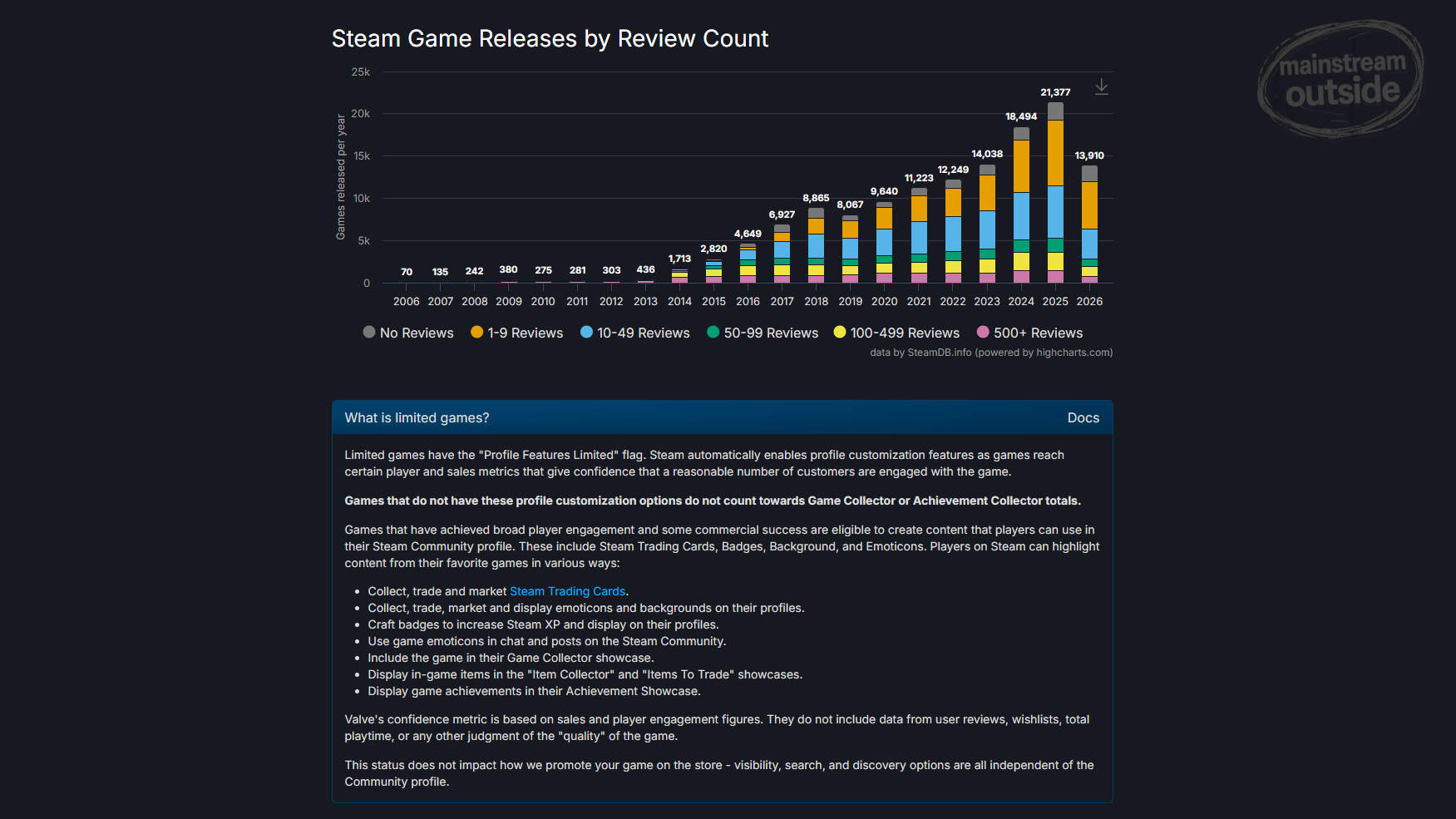
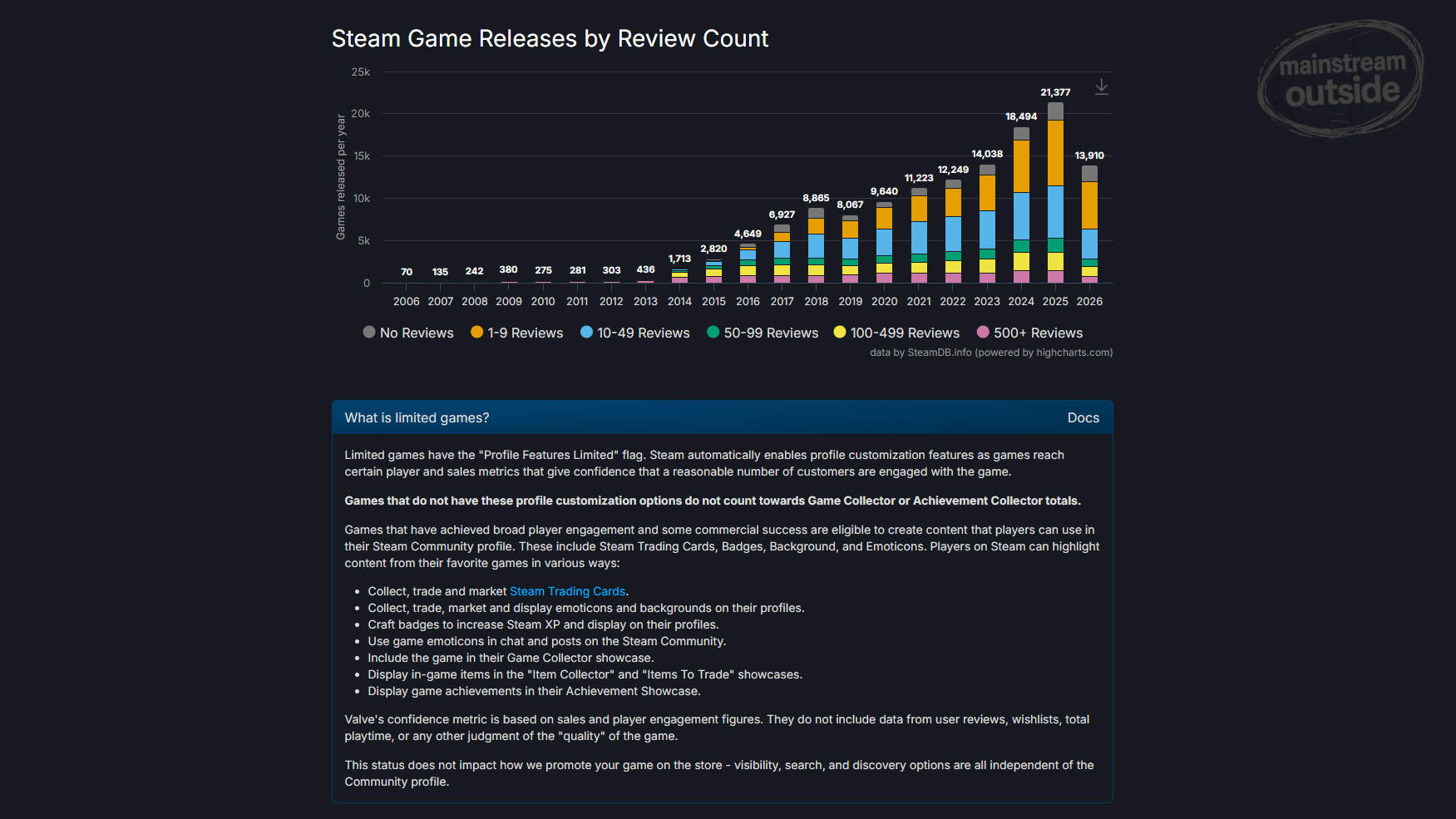
Anyway, how many Steam games do you think earn enough to cross the $1,000 threshold for recovering the Steam Direct fee? There’s no definitive answer. But we can get a rough idea from a SteamDB statistic called “Steam Game Releases by Review Count”. You can see a snapshot below, although the data behind the bars is the more interesting part.
SteamDB’s “Steam Game Releases by Review Count” statistics.
Let’s look at the review counts for products released on Steam in 2025. A total of 21,377 releases appeared in GabeN’s store during that period: games, software tools, gaming documentaries, and similar things. Their user-review counts broke down like this:
- 2,108 games: no reviews
- 7,850 games: 1-9 reviews
- 6,148 games: 10-49 reviews
- 1,631 games: 50-99 reviews
- 2,174 games: 100-499 reviews
- 1,466 games: 500+ reviews
If we combine that with estimates from Game Developer, The GameDiscoverCo, and Steam Page Analyzer, and assume average revenue of $5 per sale, we get a rough picture like this:
- 5 reviews: around 100-200 sales = roughly $500-$1,000 in revenue
- 10 reviews: around 200-400 sales = roughly $1,000-$2,000 in revenue
- 49 reviews: around 980-1,960 sales = roughly $4,900-$9,800 in revenue
These figures obviously aren’t hard proof. One audience might traditionally be more or less inclined to leave reviews than another. There are also discounts, regional pricing, refunds, bundles, keys, and the simple fact that not every product on Steam sells for the same price.
But they do provide useful ballpark figures. And from that perspective, the nearly 10,000 Steam releases from 2025 with fewer than ten user reviews no longer look like a handful of outliers. They look like a structural part of the system. Around 46 percent of all releases that year fell into SteamDB’s “no reviews” or “1-9 reviews” categories. Among cheap, tiny projects in particular, a large share of those titles probably never reached the threshold at which Valve credits the fee back.
For a multibillion-dollar company, the income from those submission fees is obviously peanuts. But the statistics above show that the Direct model continues to pay off year after year. Then there’s Steam’s 30 percent revenue cut, which also applies to any DLC and in-game purchases. The longer Valve keeps the Direct game going, the more profitable it becomes.
As I said earlier, Newell and his crew probably consider the ever-growing mountains of gaming garbage to be collateral damage. Steam’s condition hurts developers most, while algorithms keep the mess hazy enough that users don’t see all of it. At least to some extent. Apparently, even the best algorithm can’t hide the summit of Mount Trash.
The business of newcomers and hobbyists
The case is pretty clear, then: Valve, too, has discovered newcomers and hobbyists—and they’re taking the bait at the company that Half-Life built in ever-greater numbers. “Too”? Yes. Even Steam Direct’s predecessor, Greenlight, reminded me strongly of how the music industry responded to the rise of widely available internet access.
When record sales began falling more than two decades ago thanks to MP3s and the like, record executives, music magazines, and event organizers changed course. They asked themselves: “Why work exclusively with professionals and pay through the nose when we can exploit people’s dreams of fame instead?” Et voilà: labels and agencies began employing entire armies of inbox-bothering sales reps.
One tactic used by some record labels was to assemble an enormous catalog made up mostly of unknown bands and their music, then fire the whole thing at radio stations without doing any further promotion. Sound familiar? Exactly—the small stuff added up here, too. At the same time, labels signed artists to promotional contracts that were considered fulfilled as soon as their music had been sent to radio stations. The cost to the label? Little more than someone’s time.
Steam obviously has no need to go knocking on doors. In the music business, its online distribution clout would have dwarfed Warner Music circa 1982. Developers hungry for money and recognition will all end up knocking on Gabe’s door sooner or later. And—to Steam’s credit—the platform has no need to resort to underhanded tactics. Or do you honestly think I ever saw a single cent from the music sales covered by my three record contracts? Nope, kids: become game developers instead of professional musicians. 😉
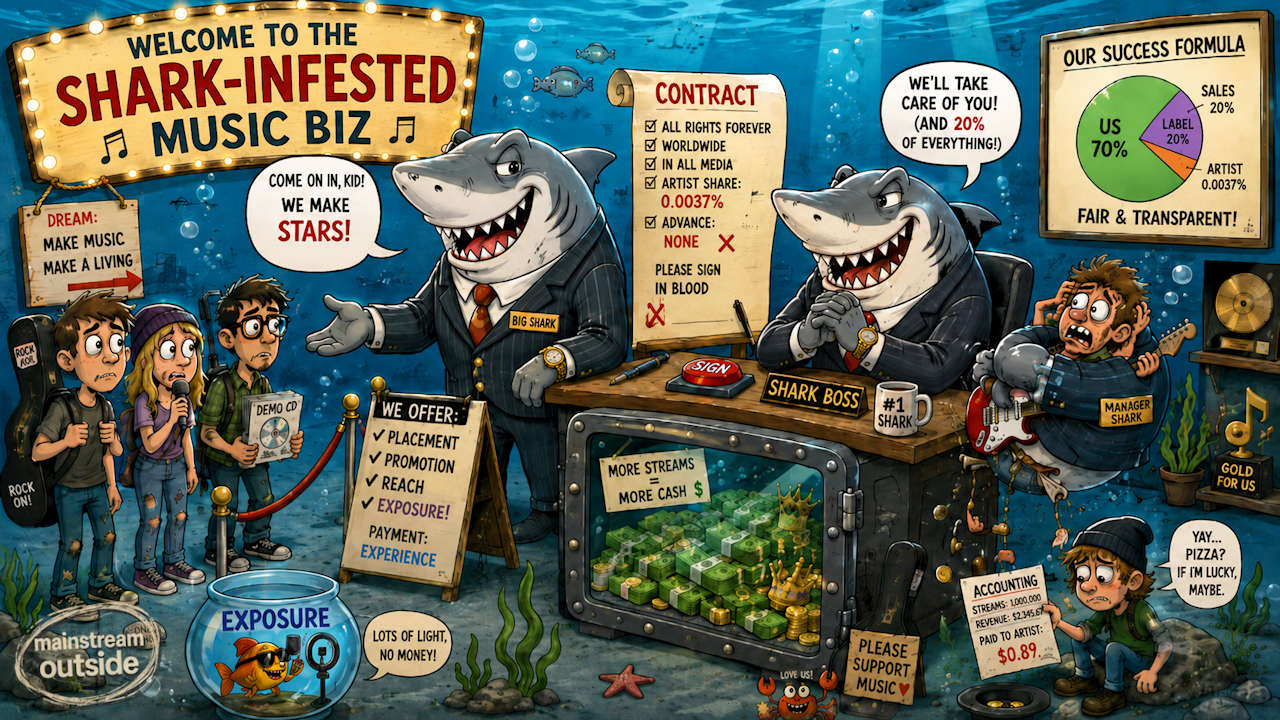
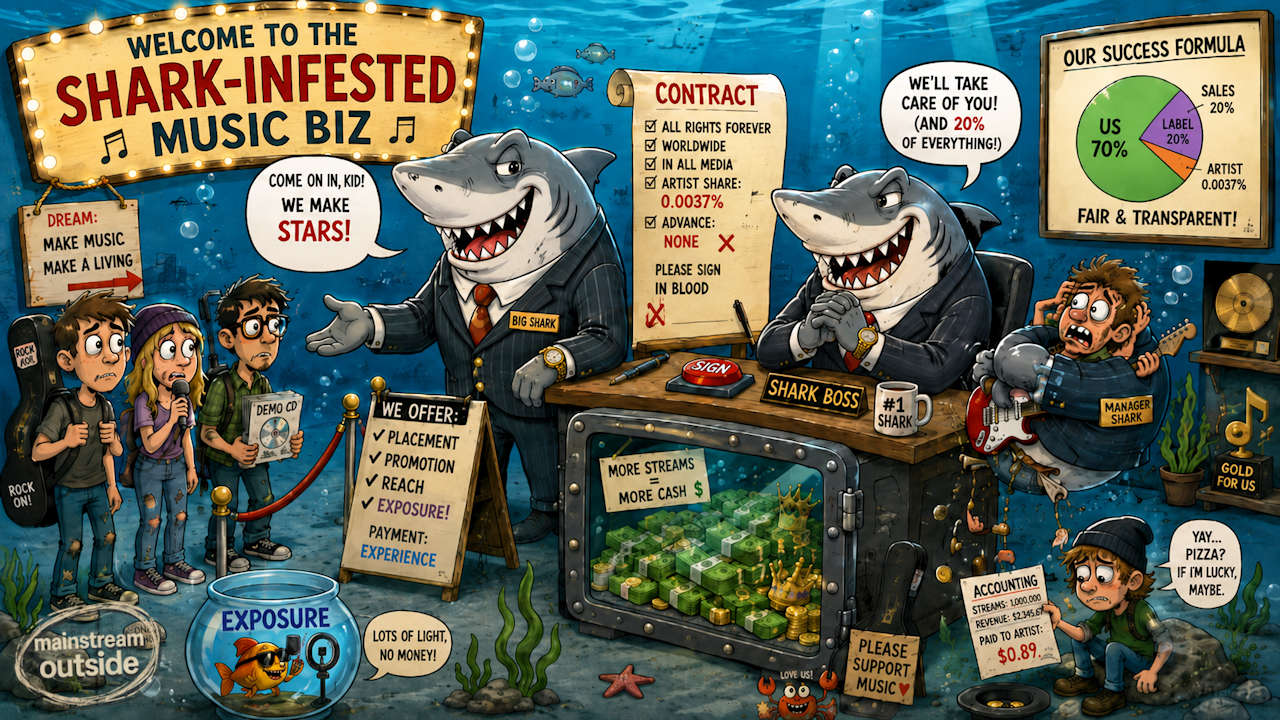
I wish this satirical depiction of the music business weren’t so painfully accurate.
Steam is turning into a run-down game discounter
Dear Steam, you come with plenty of drawbacks for users—DRM, no actual ownership rights, and opaque data practices, to name just a few—but you also have your strengths. Scrolling through your virtual aisles sometimes felt a little like Christmas. You don’t just give generic AA(A) games a platform. You also make room for ideas that are interesting, weird, and rough around the edges.
That means you’re bursting with passion, in a way. But you’ve also spoiled the Christmas magic for me more than once. If you were a grocery store, your displays and shelves would remind me of discount supermarkets 40 years ago. I’d walk past fresh leeks and heads of cabbage, only to find stinking, rotten tomatoes lying between them. One shelf would show Brand X at its absolute best; right next to it, a hundred cartons of UHT milk would be going sour on wooden pallets.
Honestly, Steam, I preferred shopping at regular supermarkets back then. Even their cheapest shelves carried more of the good stuff. And where do you think I spent more money? Exactly: at the supermarkets. Even I, a retail-apprenticeship dropout, know that presentation and atmosphere matter when you’re trying to sell something. I’m also more inclined to trust a store that puts mostly decent products in front of me. And that principle doesn’t only apply to food.
You may have noticed, Steam, that I’m describing my experiences with you in the past tense. That’s because you lost me a long time ago. I have no interest in buying temporary licenses to use things. These days, I only shop with you when there’s absolutely no way around it—and I’m convinced you’ll lose plenty more users as the renewed ownership debate gathers steam.
Normally, this is where I’d suggest that you start renting out better products across the board, since you’re not actually selling them. But my left big toe tells me your boss will keep lazily waving his scepter and orb around until the first serious attack from China arrives.

Read next:
Comments